
Does AI Actually Increase Law Firm Revenue?

CollBox Team
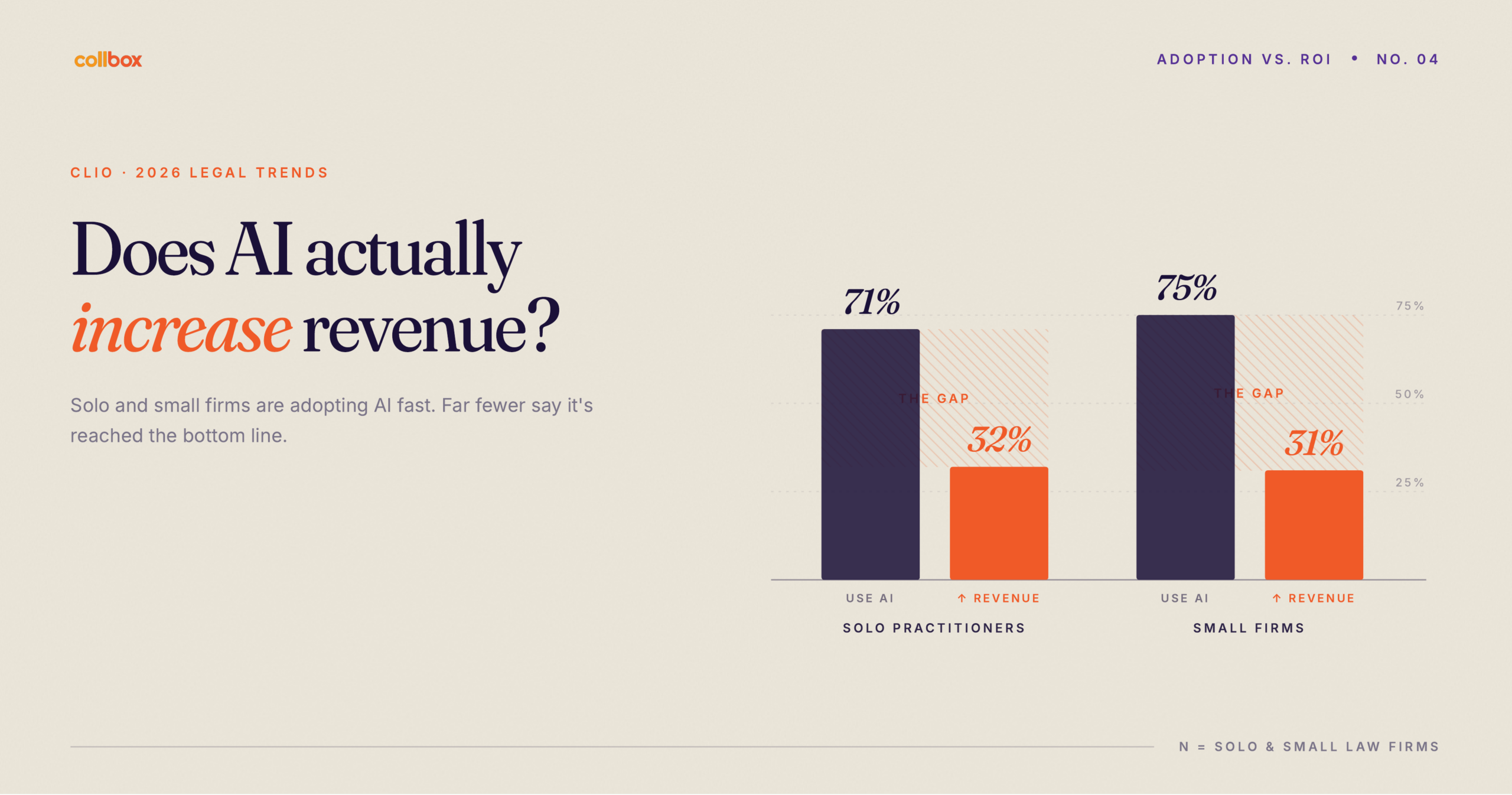
Solo and small law firms are adopting AI at a rapid clip, but most aren’t seeing it on their bottom line. According to Clio’s 2026 Legal Trends for Solo and Small Law Firms report, 71% of solo practitioners and 75% of small firms now use AI in their practice. Only 32% of solos and 31% of small firms report that it has actually increased revenue.
The efficiency gains are real. The financial returns, for most firms, are not.
Why does AI improve productivity without improving profit?
Clio frames it plainly: if AI helps you complete a task in one hour instead of five and you bill by the hour, you’ve handed your client an 80% discount. The time savings belong to them, not you.
This is what Clio calls the efficiency paradox. Firms get faster. They feel better about their work. They experience less stress and better work-life balance, all things the report documents clearly. But faster doesn’t mean more profitable unless the time saved gets redirected into new billable work or priced differently.
The firms seeing the strongest financial returns from AI adoption are doing three things, according to Clio: rethinking their pricing models, actively filling their new capacity with clients, and using integrated tools rather than a mix of disconnected software.
Most solo and small firms aren’t doing any of those three things yet. 86% of solo firms and 78% of small firms have made no pricing changes in response to AI, compared to just 51% of mid-market and 46% of enterprise firms.
What does the AI efficiency gap actually look like inside a firm?
Picture a solo family law attorney who used to spend six hours drafting a retainer agreement and supporting documents. With AI, that’s down to two hours. If she’s billing hourly, she just billed four fewer hours. If she’s on a flat fee, she pocketed the time difference, but only if she fills those reclaimed hours with another client or matter.
About a third of solo (32%) and small firms (31%) have increased revenues with AI, compared to 39% of mid-market firms and 59% of enterprise firms. A further 24% of solos and 23% of small firms say AI has had no impact on revenue at all.
The gap between solo/small firms and enterprise firms isn’t really about AI adoption rates. It’s about operational maturity around pricing, pipeline, and systems.
Is the hourly billing model disappearing?
It’s declining steadily. Since 2019, solo firms billing exclusively by the hour fell from 55% to 50%, while small firms saw an even steeper drop from 53% to 43%.
The shift matters for AR management too. Flat fee and hybrid pricing models change when and how invoices come due. Retainer depletion cycles, post-matter balance collection, and payment plan management all become more complex as hourly billing fades. Firms moving away from hourly need a more systematic approach to following up on what they’re owed, not a looser one.
Where does AR fit into the AI efficiency story?
Clio’s report focuses on future revenue, which is the right conversation. But there’s a parallel problem that AI adoption doesn’t touch at all: the revenue firms have already earned and haven’t collected.
CollBox works specifically with law firms on accounts receivable management. The pattern we see repeatedly: firms that are doing everything right operationally, including adopting AI, improving their intake, and delivering excellent client service, are still carrying five and six figures in outstanding invoices sitting in their aging reports because no one is systematically following up on aging balances.
“Getting faster at doing legal work is valuable,” says CollBox co-founder Matt Darner. “But if your AR process is still ad hoc, you’re optimizing the front end of your practice while the back end leaks.”
The Clio data suggests that turning AI efficiency into revenue requires deliberate action on pricing and pipeline. It also requires keeping the revenue you’ve already earned. If you’ve never stress-tested what’s actually recoverable in your aging report, that’s a good place to start.
Frequently Asked Questions
Why are solo and small firms less likely to see revenue gains from AI than larger firms? The Clio report points to pricing and pipeline management. Larger firms are more likely to have adjusted their pricing models in response to AI and more likely to actively fill new capacity with clients. Solo and small firms are adopting the tools without yet adapting their business models around them.
Should law firms switch from hourly billing to flat fees because of AI? Clio’s data suggest that firms shifting to flat fees are better positioned to capture the value of AI efficiency rather than passing it to clients as a discount. 71% of legal consumers already prefer flat or fixed fees, according to Clio’s 2024 Legal Trends Report, so the client demand for this shift already exists.
What is the efficiency paradox in law firms? The efficiency paradox, as described by Clio, is the situation where AI makes lawyers faster and reduces the time spent on tasks, but because many firms still bill by the hour, those time savings reduce billable hours rather than increase profit. Working faster under an hourly model effectively discounts your own services.
How do you actually convert AI time savings into law firm revenue? Clio identifies three paths: adjusting pricing models so efficiency gains stay with the firm rather than the client, actively filling new capacity with additional client work, and using integrated tools rather than disconnected software that creates context-switching and redundant work.
Does AI help with law firm collections or accounts receivable? AI tools address the front end of legal work, including drafting, research, and document preparation. They don’t address systematic AR follow-up on outstanding invoices. That requires a dedicated process, whether handled internally or through a purpose-built solution like CollBox, which integrates directly with Clio, MyCase, and Smokeball to manage follow-up on aging receivables.
Ready to see how much your firm has sitting in outstanding invoices? Get started with CollBox.
