
Law Firm Accounts Receivable Management: The Complete Guide


CollBox Team
Every law firm has an accounts receivable problem. Some just don’t know it yet.
According to Clio’s Legal Trends Report, the average law firm waits over 90 days between performing legal work and getting paid for it. That’s three months of operating expenses funded out of pocket, three months of payroll covered before revenue catches up, and three months of compounding risk that turns profitable firms into stressed ones.
At CollBox, we’ve helped law firms recover over $100 million in outstanding invoices. This guide distills what we’ve learned from working with hundreds of firms into a practical framework for managing accounts receivable, whether you handle it in-house or bring in outside help.
What Is Law Firm Accounts Receivable?
Accounts receivable (AR) is the total amount of money owed to your firm for legal services that have been performed and billed but not yet paid. It shows up as an asset on your balance sheet, but that’s misleading. Until a client actually pays, that “asset” is just a number on a screen.
For law firms specifically, AR is complicated by several factors that don’t exist in other industries: trust accounting rules, ethical obligations to clients, limitations on withdrawing from active cases, and the reality that most attorneys never received training on billing or collections.
The Two Types of Lockup (and Why Both Matter)
The gap between doing work and getting paid breaks down into two distinct phases.
Realization lockup is the time between performing billable work and sending an invoice. According to Clio, this averages 38 days. That’s more than five weeks where completed work sits unbilled, often because attorneys are too busy with client work to sit down and finalize time entries.
Collections lockup is the time between sending an invoice and receiving payment. This averages another 45 days or more.
Combined, law firms wait an average of 83 to 97 days to collect on earned fees. If your monthly overhead is $50,000, that means you need roughly $150,000 in cash reserves just to cover the gap between work and payment. Most small firms don’t have that cushion, which is how credit card debt, lines of credit, and financial stress quietly take over.
Why Invoices Go Unpaid
After recovering $100M+ for law firms, we’ve seen consistent patterns in why clients don’t pay. Understanding these is the first step toward fixing the problem.
Sticker shock. The client didn’t expect the bill to be that high. This is almost always a communication failure at intake, not a collections failure after the fact. When clients understand what to expect and receive regular billing updates, payment rates improve dramatically.
Life happens. Clients dealing with divorces, criminal charges, or business disputes are often under financial stress themselves. They’re not refusing to pay out of malice. They genuinely can’t, or they’re overwhelmed and the invoice falls through the cracks.
Confusion. Invoices that are unclear, overly detailed, or difficult to understand create friction. If a client doesn’t understand what they’re paying for, they delay.
No consequences. If your firm sends one invoice, waits 60 days, sends another, and then does nothing, clients learn that there’s no urgency. This is the “threats without teeth” pattern we see across practices of all sizes.
The relationship buffer. Attorneys hesitate to follow up because they don’t want to damage the client relationship. So they wait. And wait. And what starts as a 30-day invoice becomes 90, then 180, then a write-off.
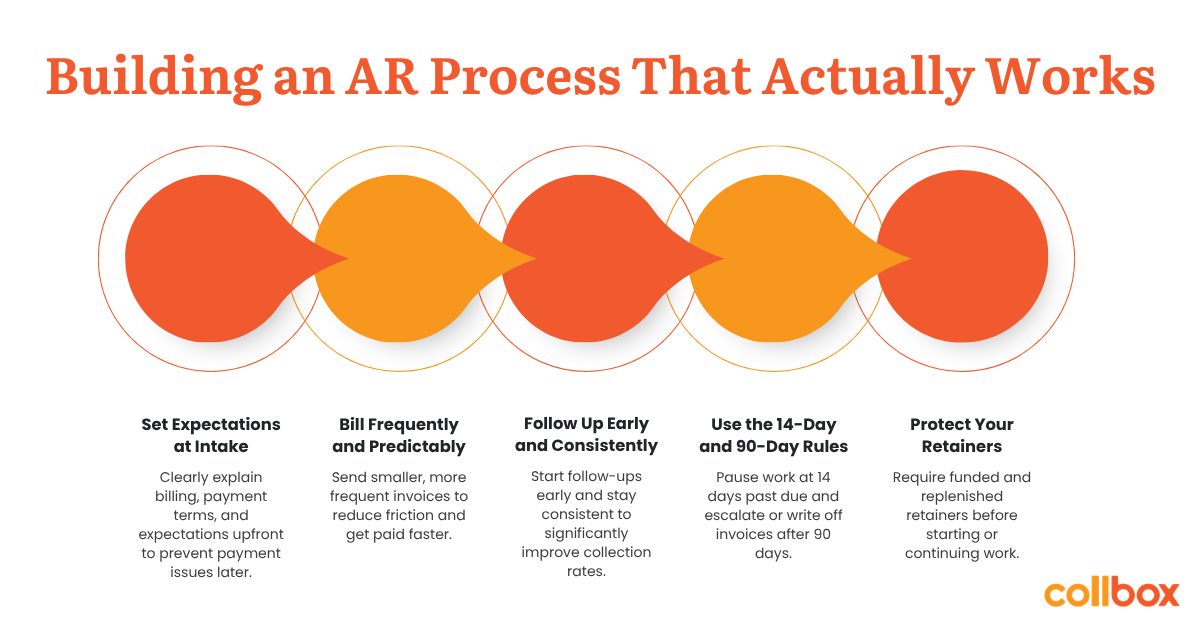
Building an AR Process That Actually Works
The firms with healthy cash flow aren’t doing anything sophisticated. They’re doing something simple, consistently. Here’s the framework.
Set Expectations at Intake
The collections conversation starts before you ever send an invoice. During intake, communicate your billing structure clearly: how often you bill, what payment methods you accept, what happens when invoices go unpaid, and what the client can expect the total cost to look like based on similar cases.
This isn’t just good business practice. It’s the single most effective thing you can do to prevent AR problems.
Bill Frequently and Predictably
Monthly billing is standard, but biweekly billing often performs better. Smaller, more frequent invoices reduce sticker shock, align with clients’ payroll cycles, and create a pattern that normalizes payment. The data supports this: firms that bill more frequently get paid faster.
Follow Up Early and Consistently
The biggest mistake we see is waiting too long to follow up. A friendly reminder at 7 days past due is dramatically more effective than a stern notice at 60 days. The longer you wait, the harder it gets to collect.
A basic follow-up cadence might look like this: a reminder at 7 days, a phone call at 14 days, a firmer reminder at 30 days, and an escalation conversation at 45 days. The specific timing matters less than the consistency. The point is that someone follows up, every time, without exception.
Our own data shows that adding personal touchpoints like phone calls can reduce payment times by up to 40%.
Use the 14-Day and 90-Day Rules
Two rules that protect your firm’s cash flow:
The 14-day rule: Once an invoice hits 14 days past due, pause all legal work for that client until they pay. This isn’t punitive. It’s a boundary that communicates you take payment seriously. Obviously, ethical obligations apply. You can’t abandon a client mid-trial. But where you have discretion, use it.
The 90-day rule: Once an invoice crosses 90 days, your chances of collecting drop significantly. If you haven’t been following up consistently during those 90 days, the odds get even worse. At this point, you either need to escalate (bring in outside help) or prepare to write it off. Waiting longer rarely improves the outcome.
Protect Your Retainers
If your practice uses retainers, treat them as a non-negotiable safety net. Work should not begin or continue unless the retainer is funded. When a retainer depletes, replenishment should be required before additional work proceeds.
This is especially critical in family law, where retainers deplete faster than expected and attorneys often can’t withdraw from cases when clients stop paying.
When to Outsource AR Management
There’s a point where managing AR in-house costs more than it saves. Here’s how to know you’ve crossed it.
Your “dedicated” AR person has five other jobs. In most small firms, the person responsible for collections is also handling intake, billing, scheduling, and client communication. Collections always loses the priority contest because it’s uncomfortable and non-urgent, until it becomes a crisis.
You’re writing off receivables regularly. If invoices routinely age past 90 days and end up written off, that’s not a client problem. It’s a process gap.
Attorneys are spending time on collections. If a partner billing at $300/hour is spending time chasing $2,000 invoices, the math doesn’t work. That time has a direct opportunity cost.
Your AR balance keeps growing. If total outstanding AR is climbing quarter over quarter despite consistent revenue, your collection rate is falling behind your billing rate. That gap only widens.
The real cost of chasing invoices often exceeds what firms realize when you account for attorney time, staff time, emotional toll, and opportunity cost.
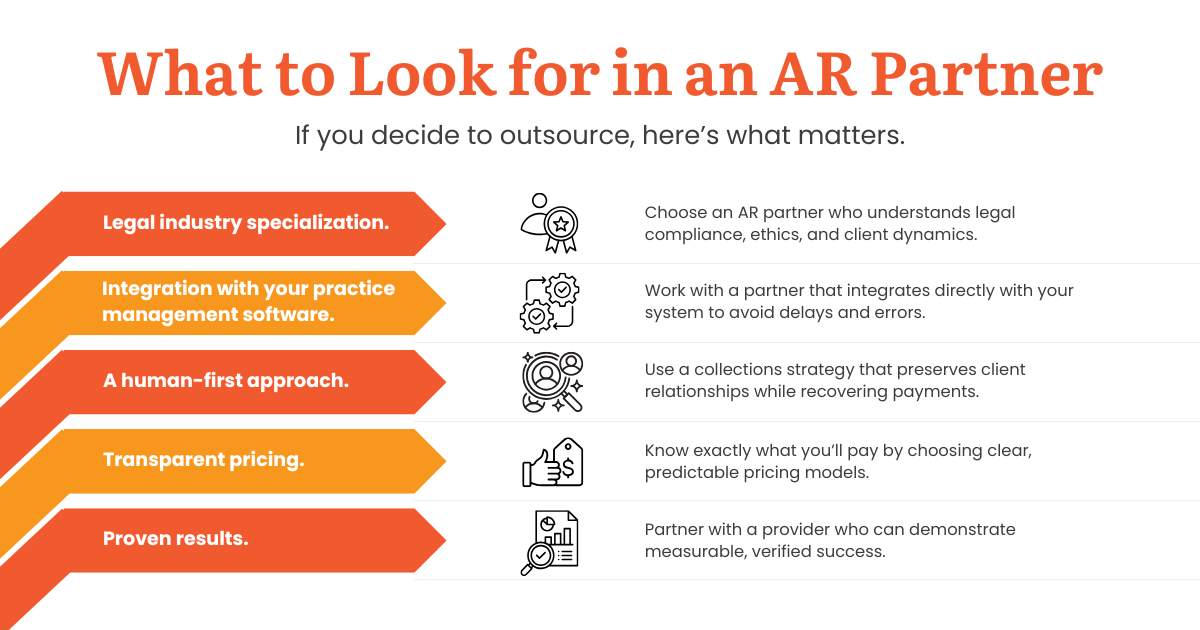
What to Look for in an AR Partner
If you decide to outsource, here’s what matters.
Legal industry specialization. Law firms have unique ethical obligations, trust accounting requirements, and client relationship dynamics. A generic collections agency doesn’t understand these constraints and can create compliance problems.
Integration with your practice management software. Your AR partner should connect directly to Clio, MyCase, Smokeball, or whatever system you use. Manual data entry creates lag and errors.
A human-first approach. These are your clients. The people who owe you money are often the same people who will refer you new business or come back for future legal work. Aggressive collections tactics can recover dollars while destroying relationships. The best approach combines smart automation with human judgment.
Transparent pricing. Understand exactly what you’re paying. Percentage-based fees on recovered amounts can get expensive quickly. Flat-fee models give you predictability.
Proven results. Ask for specifics. How much have they recovered? What’s the average time to payment? What do their clients actually experience? Results should be measurable and verifiable.
The Bottom Line
Accounts receivable management isn’t glamorous. Nobody went to law school to chase invoices. But for small and mid-sized law firms, it’s often the difference between a firm that builds wealth and one that accumulates debt.
The good news is that fixing AR doesn’t require a complete overhaul. It requires a consistent process, clear client expectations, timely follow-up, and the willingness to either dedicate resources to it or bring in a partner who will.
The easiest cash your firm will ever find is the money you’ve already earned.
If your firm is sitting on aging receivables, schedule a conversation with our team to see what recovery looks like for a practice like yours.
