
At 90 Days, You’ve Already Lost Nearly Half: A Guide to When to Act on Overdue Invoices

CollBox Team
Most law firms treat overdue invoices as a single category: unpaid. But not all unpaid invoices are created equal, and treating a 30-day-old invoice the same as a two-year-old one is one of the most expensive mistakes a firm can make.
The reality, backed by collections data, is that your window to recover what you’re owed closes faster than most attorneys realize. Here’s what the numbers actually look like, and what to do at each stage.
The Number One Factor
When Matt Darner, co-founder of CollBox, consults with law firms about their accounts receivable, he gets asked some version of the same question constantly: which invoices are actually worth chasing?
His answer is consistent: the number one factor is age.
That sounds obvious until you see what it actually means in practice. Most firms instinctively know that older invoices are harder to collect. What they don’t know is how fast the window closes, or how steep the drop-off really is.
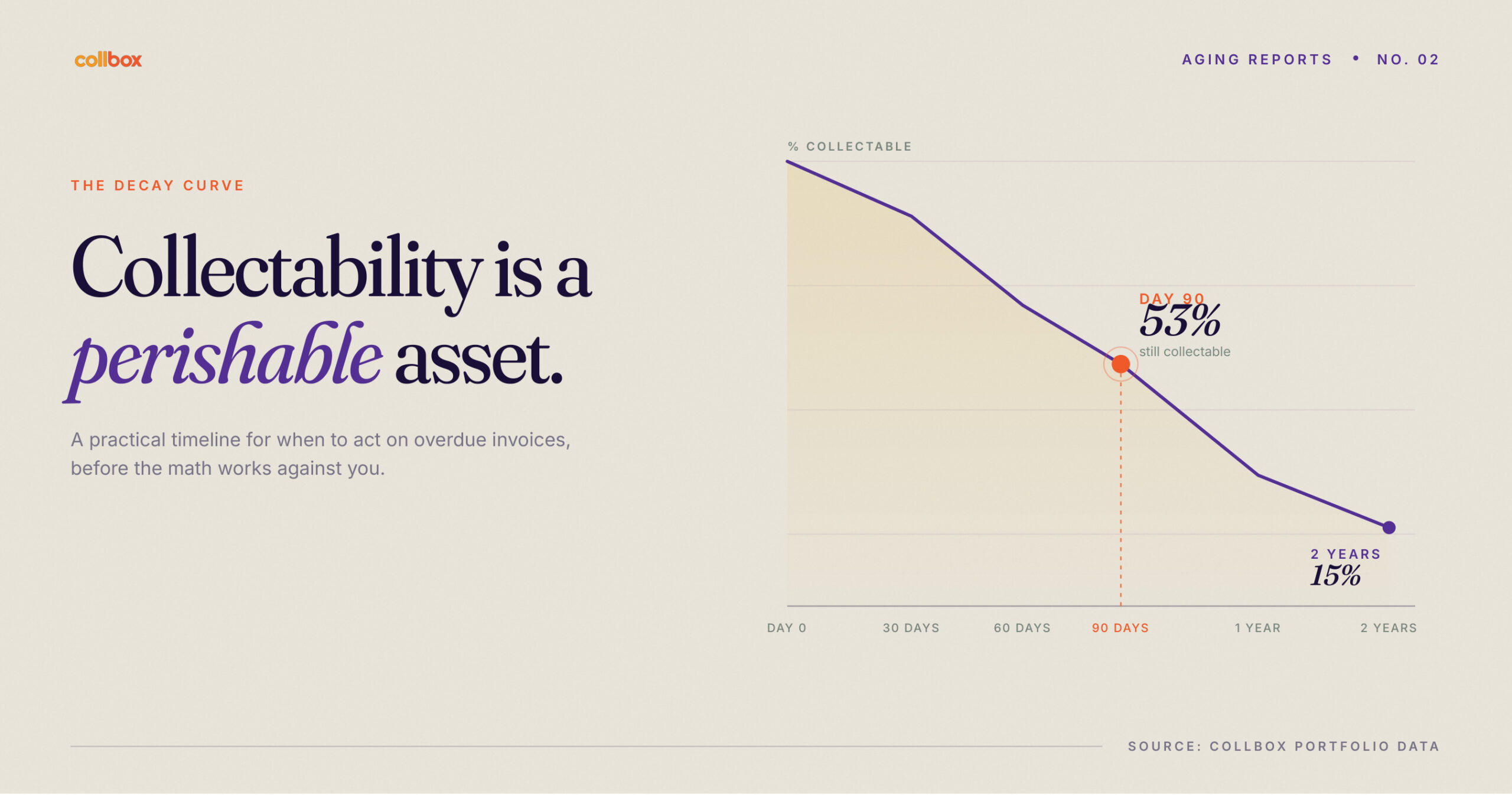
According to data CollBox has tracked across thousands of law firm invoices, by the time an invoice hits 90 days past due, it has already lost as much as 47% of its collectability. Not 90 days since it was sent. Ninety days since it went past due.
That means an invoice that’s been sitting unpaid for four to five months total isn’t just inconvenient. It’s already worth roughly half of what it was when the client first missed the due date.
Matt shared this data in a recent conversation on Ruby Powers’ Power Up Your Practice podcast, one of several appearances where he’s broken down the collections math that most attorneys don’t see until it’s too late. He made a similar case on the Financially Legal podcast with Emery Wager, where the conversation covered the gap between doing legal work and actually getting paid for it.

What Happens After 90 Days
The drop-off doesn’t stop at 90 days. It keeps going.
By the time an invoice reaches the one-year mark, collectability has deteriorated significantly. At two to three years past due, CollBox’s own recovery data shows success rates in the mid-teens, around 15 to 16 percent. That means for every dollar a firm is owed on a two-year-old invoice, there’s roughly an 85-cent chance it’s gone for good.
This is worth sitting with for a moment. Law firms sometimes avoid addressing old AR because they’re busy, or because the idea of writing off large numbers is psychologically difficult. But the longer that avoidance continues, the less there is to recover.
Here’s one way to think about the stakes: for a small or mid-size firm carrying $500,000 in invoices that are two or more years past due, a 15% recovery rate represents about $75,000. That same pool of invoices at 90 days, even with the 47% collectability loss factored in, would have represented significantly more.
The cost of waiting isn’t theoretical. It shows up directly in how much you actually get paid. And it compounds the 93-day lockup problem that the industry already faces, where the average firm waits nearly three months between doing work and receiving payment.
The 90-Day Rule of Thumb
The practical takeaway for most firms is this: 90 days past due is a real inflection point, not just an accounting label.
Once an invoice crosses that threshold, a firm should treat it differently. That means escalating from standard billing reminders to more deliberate outreach — whether that’s a personal phone call, a structured follow-up cadence, or bringing in outside support. What it should not mean is continuing to send the same automated invoice email and hoping for a different result.
The firms that recover the most tend to have a clear trigger: at a certain number of days past due, the process changes. The invoice moves from routine follow-up to active recovery. That shift, and the speed at which it happens, often determines how much of the original amount is actually collectible.
This timing issue shows up especially sharply in family law and immigration, where the matter closing date creates a hard cutoff on the attorney’s leverage. Our piece on the unique AR challenges facing family law firms explores why the leverage window closes so fast in those practice areas.
For a closer look at what a consistent follow-up process looks like before invoices reach this stage, this piece on simplifying your billing process is a useful starting point. And if you’re still working through the psychology of why follow-up gets avoided in the first place, this guide to talking with clients about money covers the conversation side of the equation.
What to Do With Very Old Debt
For invoices that are already a year or two past due, the approach needs to be different — but that doesn’t mean doing nothing.
Matt’s recommendation for genuinely aged AR is straightforward: take a measured, time-boxed run at it. Set a specific 60 to 90-day window, define the actions you’ll take (calls, emails, formal demand), and commit to it. Whatever you recover, you recover. The rest gets written off with intention rather than just drifting into permanent limbo.
This approach is more useful than most firms realize. Keeping aged invoices on the books indefinitely doesn’t help cash flow projections, creates false impressions of firm health, and consumes mental energy every time someone runs the aging report. As Darren Wurz of the Lawyer Millionaire podcast has noted when covering this exact scenario, a firm can look profitable on paper while quietly carrying a cash flow crisis. A deliberate decision to close out what can’t be collected is a business decision, not a failure.
The key is pairing that write-off decision with a forward-looking commitment: tighten the process so next year’s invoices don’t end up in the same category. That’s the more important half of the equation. It starts well upstream of any collections conversation, at intake, retainer structure, and billing cadence. Our breakdown of what the real cost of chasing invoices looks like shows why those upstream decisions carry so much downstream weight.
The Industry Data Behind the Problem
The collectability decay numbers CollBox has observed internally line up with broader industry patterns. Clio’s Legal Trends Report has documented the lockup crisis in detail, with data showing 68% of firms cite collections as a significant challenge. That’s not a niche problem. It’s the majority of practices, and it’s driven largely by the same thing: invoices going unaddressed until they’ve aged past the point of easy recovery.
CollBox’s ABA TECHSHOW Startup Alley win earlier this year, covered by LawNext and the ABA Journal, drew directly on this data. Matt’s pitch centered on the 97-day average time to payment and the “no one owns AR” dynamic that lets invoices age unchecked. The audience — all attorneys — voted CollBox to the top.
They recognized the problem. Most firms do. The question is when they decide to do something about it.
Where CollBox Fits In
CollBox integrates directly with practice management systems including Clio, MyCase, and Smokeball to detect overdue invoices as they age, then initiates a structured follow-up process that combines automated outreach with real human phone calls from trained AR specialists. The goal is to intervene well before the 90-day cliff, when the chances of full recovery are still high.
Firms using CollBox recover an average of $66,000 per month and get paid 40% faster. If you’re looking at an aging report with numbers in the 90-plus column and you’re not sure what to do with them, schedule a conversation with Matt to talk through what’s actually there and what a recovery effort realistically looks like.
CollBox is purpose-built to help law firms recover what they’ve already earned. Winner of Clio’s 2025 Best Business of Law App Award and the 2026 ABA TECHSHOW Startup Alley competition. Learn more at collbox.co.
