
How Is AI Changing Law Firm Billing Models?

CollBox Team
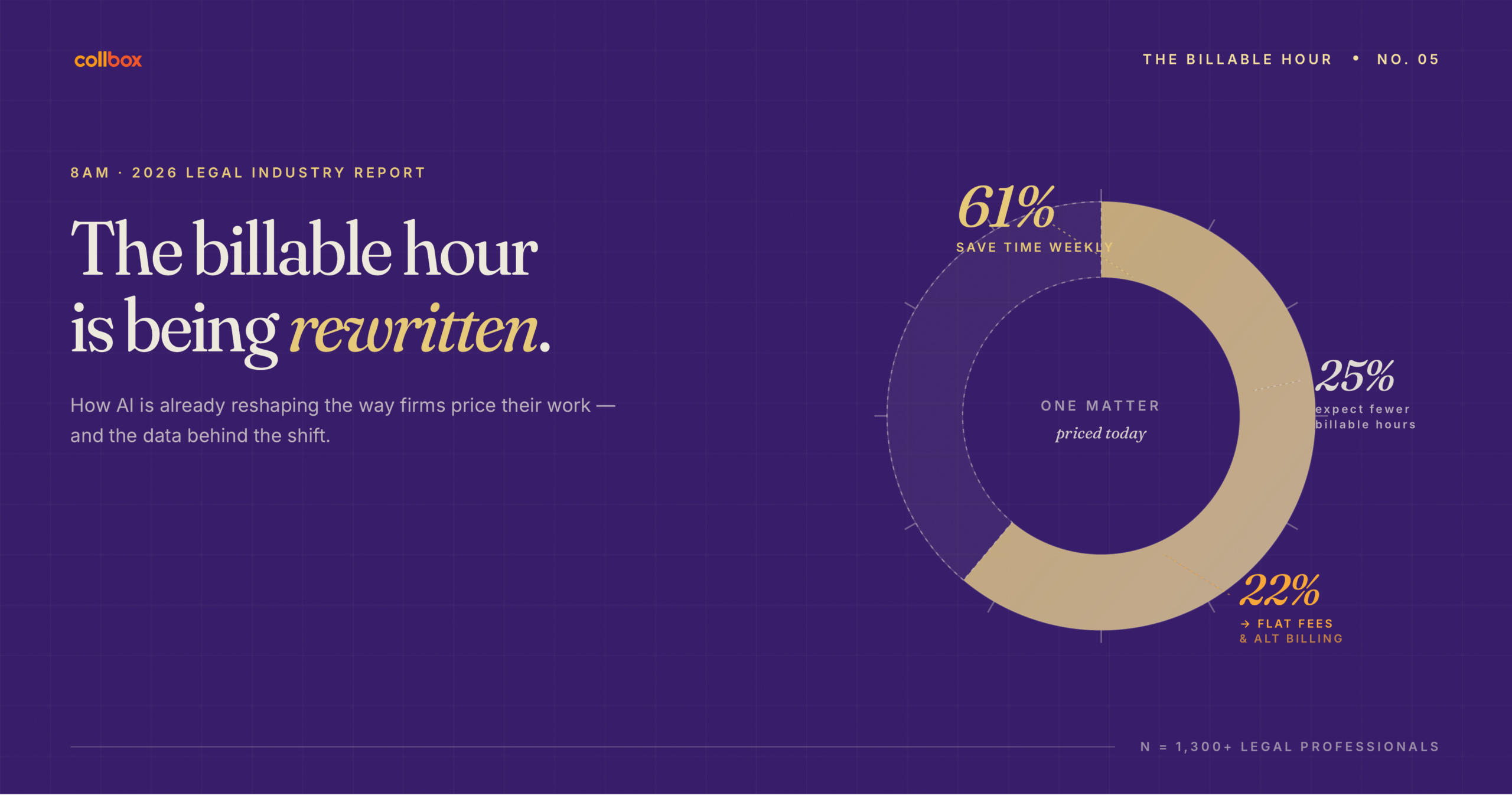
AI is already reshaping how law firms price their work, and most attorneys haven’t fully reckoned with what that means for their revenue. According to the 8am 2026 Legal Industry Report, which surveyed more than 1,300 legal professionals, 61% of respondents say AI saves them time every week. Nearly 25% expect AI to reduce billable hours per matter, and 22% expect it to accelerate the shift toward flat fees and alternative billing arrangements.
The billing model conversation is no longer theoretical. It’s already happening.
Are law firms actually saving time with AI?
The 8am data makes the productivity case clearly. Individual AI adoption among legal professionals more than doubled compared to last year, with nearly three-quarters of respondents now using general-purpose tools like ChatGPT and Claude for work-related purposes. More than half (61%) said AI saves them time each week.
More than one-third of respondents who personally use generative AI reported saving one to five hours per week, while another 14% reported saving six to ten hours weekly.
For a solo attorney billing $250 an hour, five hours saved per week is potentially $1,250 in reclaimed capacity every week. Whether that translates into revenue depends entirely on what happens next.
What does AI mean for the billable hour?
The 8am report found that nearly 50% of respondents believe AI will impact billing practices, either by reducing the number of hours spent on a matter (25%) or resulting in greater adoption of flat fees or alternative billing arrangements (22%).
The question for each firm is: who captures the value of that efficiency? Under a straight hourly model, time saved on a matter is revenue lost on that matter. Under a flat fee, efficiency gains stay with the firm.
Many experts have speculated that AI may be the death knell of the billable hour. The 8am data doesn’t confirm that, but it does confirm that the conversation is reaching attorneys at every firm size and practice area. If you’re still trying to figure out how to simplify your billing so you can focus on practicing law, the billing model question is worth getting ahead of.
Does moving to flat fees change how you need to manage collections?
Yes, and this is a point that gets overlooked in most billing model discussions.
Hourly billing creates a natural checkpoint for payment. Clients see incremental bills, often monthly, and the relationship between work performed and invoice is transparent. Flat fee arrangements front-load the revenue expectation, which sounds better until clients don’t pay the initial retainer on time, let the retainer run dry mid-matter, or go silent after case closure.
This is especially pronounced in practice areas like family law, where retainer depletion and post-case ghosting are already common problems under any billing model.
CollBox works with law firms at every stage of this transition. The firms that shift to flat fees without upgrading their AR follow-up process often find that the billing model change didn’t solve their cash flow problem; it just moved it.
“Flat fees can absolutely increase margin,” says CollBox co-founder Matt Darner. “But if your follow-up process is still inconsistent, you end up with the same unpaid balances, just harder to track because there are fewer invoice touchpoints along the way.”
Are law firms prepared for AI-driven billing changes?
The 8am report suggests a significant readiness gap. More than half of respondents (54%) said their firm provided no training on the responsible use of AI and had no plans to do so. If firms aren’t training for AI use itself, they almost certainly aren’t preparing for the downstream billing and financial management changes AI creates.
Only 19% of legal professionals said their firm is very prepared to manage the changes generative AI will bring over the next five years.
The firms most exposed to the billing model shift are the ones already adopting AI for efficiency without updating their pricing structures or their AR processes to match. A 15-minute AR audit is often the fastest way to see where those gaps are showing up in real dollars.
What about billing for AI tool usage itself?
The 8am report finds that client pressure for AI-related price reductions has not yet materialized, with 83% of respondents saying clients are not pushing for cost reductions linked to their firm’s use of AI. That window won’t stay open indefinitely.
Firms have a near-term opportunity to capture AI efficiency gains before client expectations shift. That means adjusting pricing now, building systematic AR follow-up into flat fee engagements, and not assuming that time saved automatically becomes revenue. If talking to clients about money is already a friction point in your practice, a billing model transition without a collection system behind it will amplify that friction.
Frequently Asked Questions
How is AI affecting law firm billing? The 8am 2026 Legal Industry Report found that nearly half of legal professionals expect AI to impact billing practices, either by reducing billable hours per matter or accelerating adoption of flat fees. The firms capturing the most value from AI are those adjusting their pricing models rather than passing the efficiency gains to clients through reduced hours.
Will AI eliminate the billable hour for law firms? The 8am data doesn’t show the billable hour disappearing, but it does show it declining. Solo firms billing exclusively by the hour dropped from 55% to 50% since 2019 according to Clio’s data, and small firms fell further. The trend is consistent across multiple data sources.
What happens to law firm collections when you switch to flat fees? Flat fee billing changes the structure of when invoices come due and how payment disputes surface. Without a systematic AR follow-up process in place, flat fee firms can end up with harder-to-track outstanding balances. CollBox integrates with Clio, MyCase, and Smokeball to manage AR follow-up regardless of billing model.
Are law firms training staff on AI? Most are not. The 8am report found that 54% of firms have no training on responsible AI use and no plans to develop any. That gap extends to the financial and billing implications of AI adoption, which most firms are navigating without structured guidance.
How much time are attorneys actually saving with AI? The 8am report found that 38% of AI users save one to five hours per week, 14% save six to ten hours weekly, and smaller groups save even more. Only 6% reported no productivity benefit from AI use.
Want to understand what your AR looks like before and after a billing model shift? Get started with CollBox.
