
Should a Law Firm Use AI to Collect Unpaid Invoices?

CollBox Team
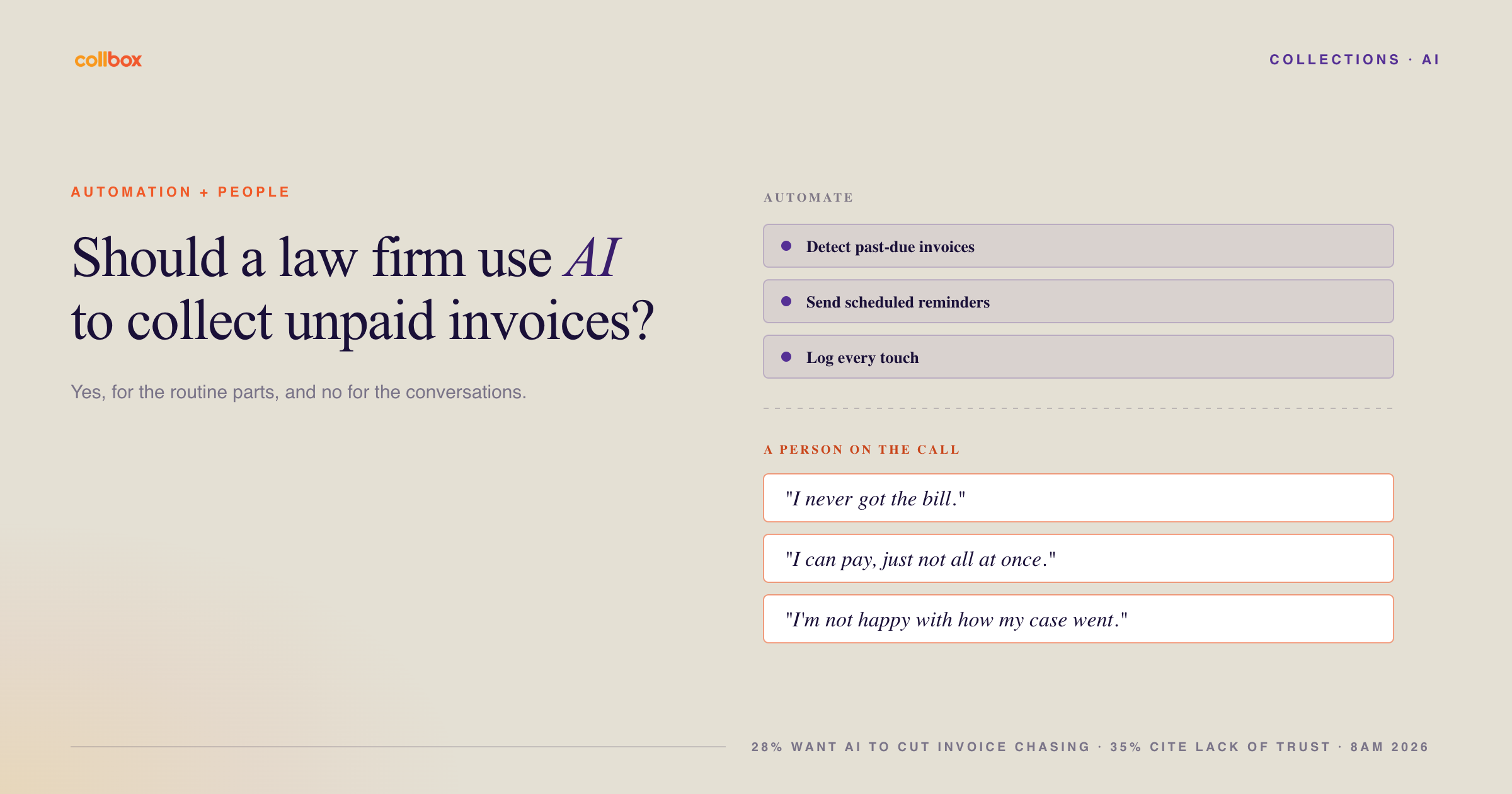
Yes, for the routine parts, and no for the conversations. AI and automation are well suited to spotting past-due invoices, sending consistent reminders, and logging every touch. The calls and replies where a client explains why they haven’t paid still need a trained person, because those moments involve judgment, confidentiality, and the client relationship. The safest setup for most small and mid-sized firms combines both, with the firm able to see everything that happens.
Legal professionals clearly want help here. In 8am’s 2026 Admin Misery Index, 28% of legal professionals named payment collection or invoice chasing as a task they’d like AI to reduce or eliminate. The same survey found real hesitation: 35% cited a lack of trust in AI, and 25% pointed to privacy or confidentiality concerns.
At CollBox, we run accounts receivable follow-up for small and mid-sized law firms on Clio, MyCase, and Smokeball. We use automation heavily, and we still put a person on every call. Here’s how we think about the line.
What parts of law firm collections can AI handle well?
The repeatable work is a good fit for automation:
- Detecting past-due invoices the day they cross the line, straight from your practice management system.
- Sending reminders on a fixed schedule with the invoice attached and a live payment link, so the easy payers pay without anyone lifting a finger.
- Logging every touch so the firm can see who was contacted, when, and what happened.
- Flagging patterns, like a client who opens every email and never pays, or a balance that jumped after a large invoice.
This work is mostly clerical. It’s also the work that gets skipped when a firm is busy, which is why automating it pays off.
Where does AI fall short in collecting legal fees?
The moment a client responds, collections stops being clerical. Here are the replies our team hears every week:
- “I never got the bill.”
- “My attorney said I’d get a discount on this.”
- “I can pay, just not all at once.”
- “There’s a hearing next week where the other side might have to pay my fees.”
- “I’m not happy with how my case went.”
Each one needs a different response. Some should be handled on the spot, and some should go straight to the responsible attorney. A service complaint dressed up as a payment problem is a warning sign that a partner needs to hear about quickly. A script, however well written, doesn’t know the difference.
Tone matters just as much. A consumer law firm lives on reviews and referrals, and a clumsy collection call can cost more than the invoice was worth.
Does using AI for collections create ethics or confidentiality risk?
It can. The duty of confidentiality doesn’t end when a client stops paying, and a firm remains responsible for what a third party does on its behalf. Any tool or service that touches client billing data is handling information related to the representation.
That makes two questions worth answering before you connect anything: what client data leaves your practice management system, and where does it go? If a vendor sends client information into a general-purpose AI model, you need to know that before your clients’ names and balances are in it.
Many firms haven’t set rules for this yet. Clio’s 2026 Solo and Small Legal Trends Report found that 57% of solo firms and 55% of small firms have no AI usage policy at all. If your firm is in that group, collections is a good place to write the first one, because it involves client data, client communications, and money.
Will clients know they’re talking to AI?
They often figure it out, and many don’t like it. On a recent call with our team, an attorney who had seen a CollBox ad asked whether “calls in your voice” meant software would clone his voice to call his clients. When we explained that real people make the calls, he laughed and said the alternative would have been “a pretty weird situation.”
His instinct is a good one. Clients who owe money are often embarrassed, stressed, or frustrated. A real person who can listen, answer a question, and set up a plan resolves more of those conversations than a bot that sounds almost human.
“I think AI is going to change almost everything about how law firms run their back office, and collections is no exception. But the call is where you find out why someone isn’t paying, and that’s the most valuable information in the whole process. We automate everything around that moment so our team can spend their time on it.” Matt Darner, Co-founder and CEO, CollBox
What should a law firm ask before using an AI collections tool?
Six questions will sort most options quickly:
- Who is on the phone with my client? A person, a voice agent, or nobody?
- Whose name does the outreach use? The firm’s, or the vendor’s?
- What client data leaves my practice management system, and where does it go?
- Can I exclude specific clients, matters, or practice areas?
- Can I see every email, call, and client response?
- What happens when a client disputes a bill or raises a concern about the case?
If a vendor can’t answer the sixth question clearly, keep looking.
How does CollBox use automation and people together?
CollBox syncs with Clio, MyCase, or Smokeball and detects past-due invoices automatically. Automated reminders go out on a consistent schedule. A North America-based AR specialist handles the phone calls and client replies, in your firm’s name, and routes disputes and judgment calls back to the firm. Firms choose who gets contacted and can see every touch. CollBox charges a flat monthly subscription, and firms keep 100% of what’s recovered.
Frequently asked questions
Can AI make collection calls for a law firm? Technically, yes. Voice agents exist and are getting better. The question is whether you want one handling a conversation with a client who may be upset, confused, or in the middle of a hard case. Most firms we work with want a person on those calls.
Is it ethical for a law firm to use AI in collections? It can be, as long as the firm protects client confidentiality, supervises what the tool does, and stays responsible for how clients are treated. Check where client data goes before you connect any tool, and confirm your jurisdiction’s guidance on AI use.
Do automated payment reminders actually work? They work well on clients who simply forgot or lost the invoice. They don’t work on clients who have a reason for not paying, because a reminder can’t ask what the reason is. That’s the point where a person needs to step in.
What’s the difference between AI collections software and an AR service? Software automates reminders and leaves the follow-up conversations to your team. An AR service like CollBox runs the full process, including calls, in your firm’s name. Many firms start with software and add a service once they see how many clients never respond to email.
See what consistent follow-up looks like
Book a call with Matt Darner to see how CollBox works with your practice management system, or get started with CollBox.
