
How Much Revenue Does Admin Work Cost a Law Firm?

CollBox Team
According to 8am’s 2026 Admin Misery Index, about four in ten legal professionals lose at least four productive or billable hours every week to administrative work. Forty-one percent estimate that admin burden costs their firm at least $5,000 in revenue a month, and 26% put the number at $10,000 or more. The most expensive admin at a small firm is usually the work that sits between finishing a matter and getting paid for it: time entry, billing, and following up on past-due invoices.
8am surveyed 400 U.S. legal professionals in June 2026, including attorneys, paralegals, legal operations staff, and firm administrators. Every respondent had some administrative responsibility. The findings put numbers on something most firm owners already feel.
At CollBox, we work exclusively on accounts receivable for small and mid-sized law firms, integrating with Clio, MyCase, and Smokeball. The part of this report we want to focus on is the end of the chain, where admin delays turn into unpaid invoices.
What did the 2026 Admin Misery Index find about law firms?
The legal-sector findings are hard to dismiss:
- About four in ten legal professionals lose four or more productive or billable hours a week to admin work.
- 41% say admin burden costs their firm at least $5,000 in revenue a month. 26% say at least $10,000.
- 78% say admin work limits their ability to take on new clients or grow the practice, at least to some extent.
- 92% say admin work interferes with their core responsibilities to some extent, and two-thirds say it happens at least sometimes.
- 35% have delayed client work because of administrative drag.
The human cost shows up too. A third of legal professionals say admin work makes them moderately to extremely miserable, and 42% report a moderate to extreme sense of dread on Sunday nights before the workweek starts.
Which admin tasks cause law firms the most stress?
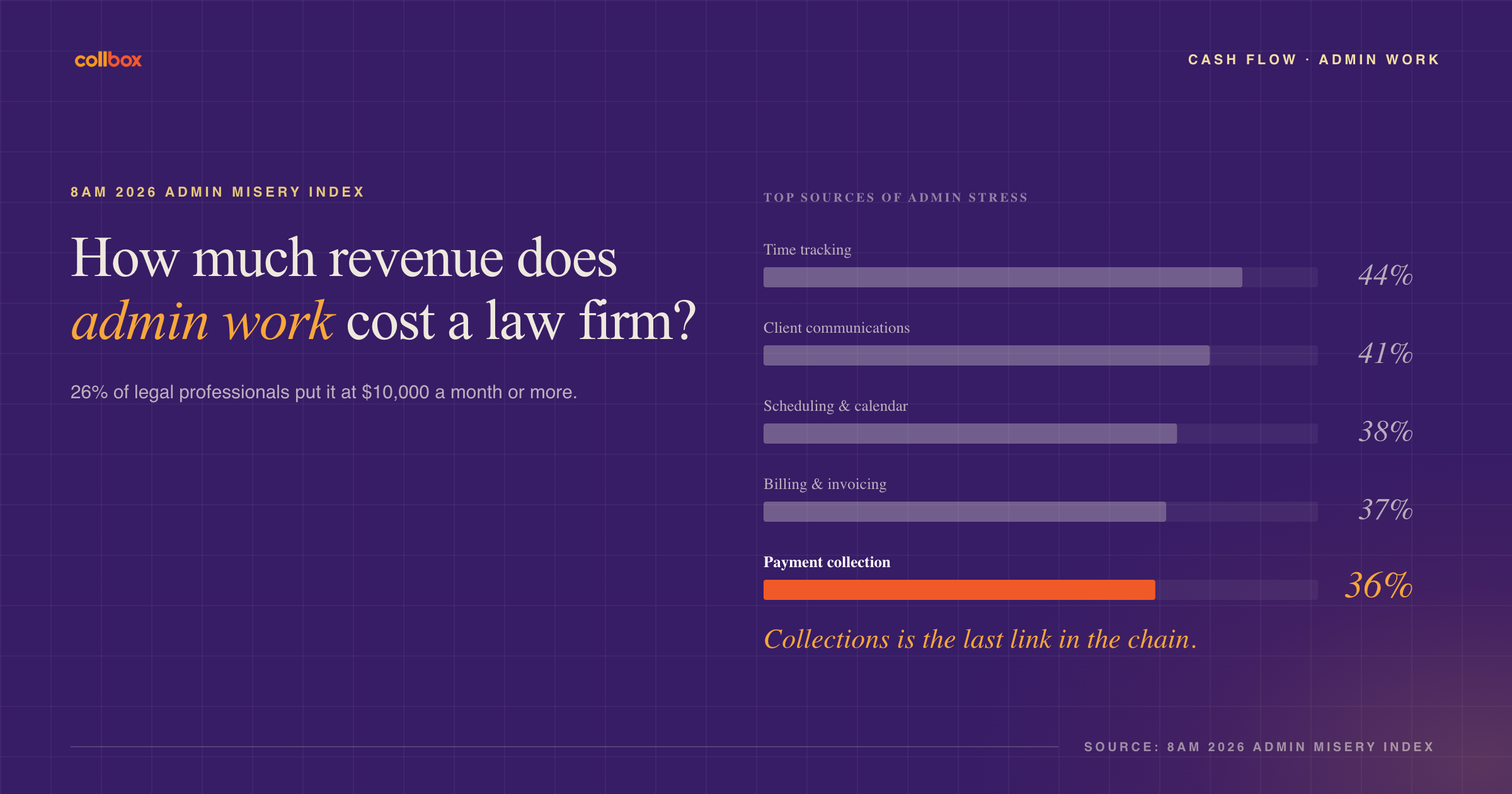
8am found that the top sources of admin stress for legal professionals were time tracking (44%), client communications (41%), scheduling and calendar management (38%), billing and invoicing (37%), and payment collection or invoice chasing (36%).
Four of those five sit on the path from work to cash. 8am describes them as a chain: time tracking failures delay billing, delayed billing stalls collection, and stalled collection creates more back-and-forth with clients.
Collections is the last link, so it absorbs every delay that came before it. A time entry reconstructed two weeks late produces a bill that goes out late. A bill that goes out late gets questioned. A questioned bill gets paid late or not at all. By the time an invoice is past due, the firm has already paid for that work twice: once to do it, and again in the hours spent billing, rebilling, and following up.
Why is payment collection such an expensive kind of admin?
Most admin costs time. Collections admin costs time and money at the same moment, for three reasons.
It lands on expensive people. At small firms, follow-up usually falls to the attorney, a paralegal, or whoever sends the invoices. Every hour an attorney spends calling about a bill is an hour not spent on billable work, and the 8am data suggests those hours add up quickly.
It gets skipped first. Follow-up has no court deadline attached. When the week gets busy, it’s the task that slides. The invoices keep going out, the calls stop, and the aging report grows while everyone assumes someone is handling it.
It gets harder to fix the longer it waits. Past-due balances become less collectible as they age. That’s why CollBox only works invoices up to 180 days past due: the newer the balance, the more a consistent follow-up process can still recover.
How can a law firm reduce the admin cost of collections?
8am’s recommendations for reducing admin drag start where the money moves. Applied to collections, that looks like this.
Connect billing, payments, and follow-up. When invoices, payment links, and past-due follow-up live in separate places, someone has to move information between them by hand. 8am’s report specifically points to integrated tools like CollBox that manage past-due invoice follow-up directly from a firm’s case management system.
Automate the routine, keep people on the judgment calls. Payment reminders with the invoice attached and a live payment link should go out on schedule without anyone deciding to send them. The conversations that follow, like disputes, hardship requests, and “I never got the bill,” still need a person.
Make follow-up someone’s actual job. A cadence that runs weekly whether or not anyone has time is worth more than an intense push at month end. If nobody at your firm can own that cadence, that’s the gap to close.
Measure it. Track how much moves into your 90+ day bucket each month. If that number keeps growing, admin burden is already showing up in your cash flow.
“What stood out to me in the 8am data is that payment collection made the top five stressors even though it’s a small share of anyone’s job description. It doesn’t take much time on paper. It takes a lot of emotional energy, and it’s the task most likely to get pushed to next week. That’s usually how a firm ends up with a big aging report and nobody who can explain it.” Matt Darner, Co-founder and CEO, CollBox
Where does CollBox fit?
CollBox is a tech-enabled accounts receivable service for small and mid-sized law firms. It syncs with Clio, MyCase, or Smokeball, detects past-due invoices automatically, and assigns a North America-based AR specialist who runs email and phone follow-up in your firm’s name. Firms choose who gets contacted, can exclude individual clients or entire practice areas, and keep 100% of what’s recovered. Payments run through the firm’s existing payment methods.
The goal is to take the most stressful, most skippable piece of the admin chain off your team’s plate while keeping your firm in control of the client relationship.
Frequently asked questions
How many hours do lawyers lose to administrative work? In 8am’s 2026 Admin Misery Index, about four in ten legal professionals reported losing at least four productive or billable hours a week to admin work. Over a year, that’s roughly 200 hours per person. For an attorney billing hourly, those hours are revenue the firm never invoices.
What administrative tasks cost law firms the most? Time tracking was the top stressor in 8am’s survey, followed by client communications, scheduling, billing and invoicing, and payment collection. These tasks are connected, so a delay in one usually shows up in the next. Collections tends to feel the most pain because it sits at the end of the chain.
Should attorneys handle collections themselves? They can, but it’s usually the most expensive way to do it. Attorney time spent on follow-up is time not spent on billable work, and it puts the person responsible for the client’s case in the position of asking that client for money. Most firms do better when someone else runs routine follow-up and the attorney handles only the escalations.
Can admin work really cost a firm $10,000 a month? Twenty-six percent of legal professionals in 8am’s survey estimated it does. Lost billable hours, delayed invoices, and unpaid balances all count toward that number, and past-due invoices are often the largest single piece at small firms.
What’s the fastest way to reduce collections admin? Automate reminders inside your practice management system and make follow-up a scheduled job for one person or service. Consistency matters more than intensity. A weekly rhythm catches problems while invoices are still recent and easy to collect.
Start where the money is
If admin is eating your week, start with the work closest to cash. Book a call with Matt Darner to walk through your aging report, or get started with CollBox.
