
How Do You Get Clients to Replenish a Retainer?

CollBox Team
Clients replenish retainers when the request carries the same weight as a bill, and they ignore it when it does not. A replenishment request typically arrives with no due date the client recognizes, no invoice number, no payment link, and no consequence attached, which means it reads as a notification rather than an obligation. Firms then keep working anyway, which teaches the client that replenishment is optional.
Fixing it requires three things: setting the expectation at intake rather than mid-matter, invoicing the replenishment on a defined trigger with a real due date, and following up on it with the same cadence you would use on any other unpaid balance.
At CollBox, we work exclusively with small and mid-sized law firms on accounts receivable, with integrations into Clio, MyCase, and Smokeball. Failed replenishment is the single most common way a firm with a retainer model ends up with a receivables problem it assumed the retainer model prevented.
Why do clients ignore retainer replenishment requests?
Because nothing about the request signals that it is a bill.
A client who receives an invoice understands the transaction. Work was performed, an amount is owed, there is a date by which to pay it. A replenishment request inverts all of that. It asks for money against work that has not happened yet, on a timeline the client did not set, in a format that often arrives as a paragraph inside an email about something else entirely.
There is also a deeper reason, which is that the request is frequently made inconsistently in the first place. CollBox co-founder Matt Darner described the underlying pattern on the ABA’s Law Practice podcast:
“Attorneys, and people in general, often dislike asking for money because it feels like it disrupts the client relationship. Consequently, they ask for money inconsistently, leading to an accumulation of accounts receivable and an inability to pay upcoming bills.”
Inconsistency is the thing clients actually respond to. A replenishment request that comes at a predictable trigger, every time, in the same format, gets treated as part of how the firm operates. One that shows up sporadically when someone remembers gets treated as a suggestion.
What happens when a retainer isn’t replenished?
The firm keeps working, and that is the whole problem.
The matter is live. There is a hearing next month, a filing deadline, a client in the middle of the worst period of their life. Nobody at the firm is going to halt work over an unfunded replenishment request, and the client, consciously or not, knows this.
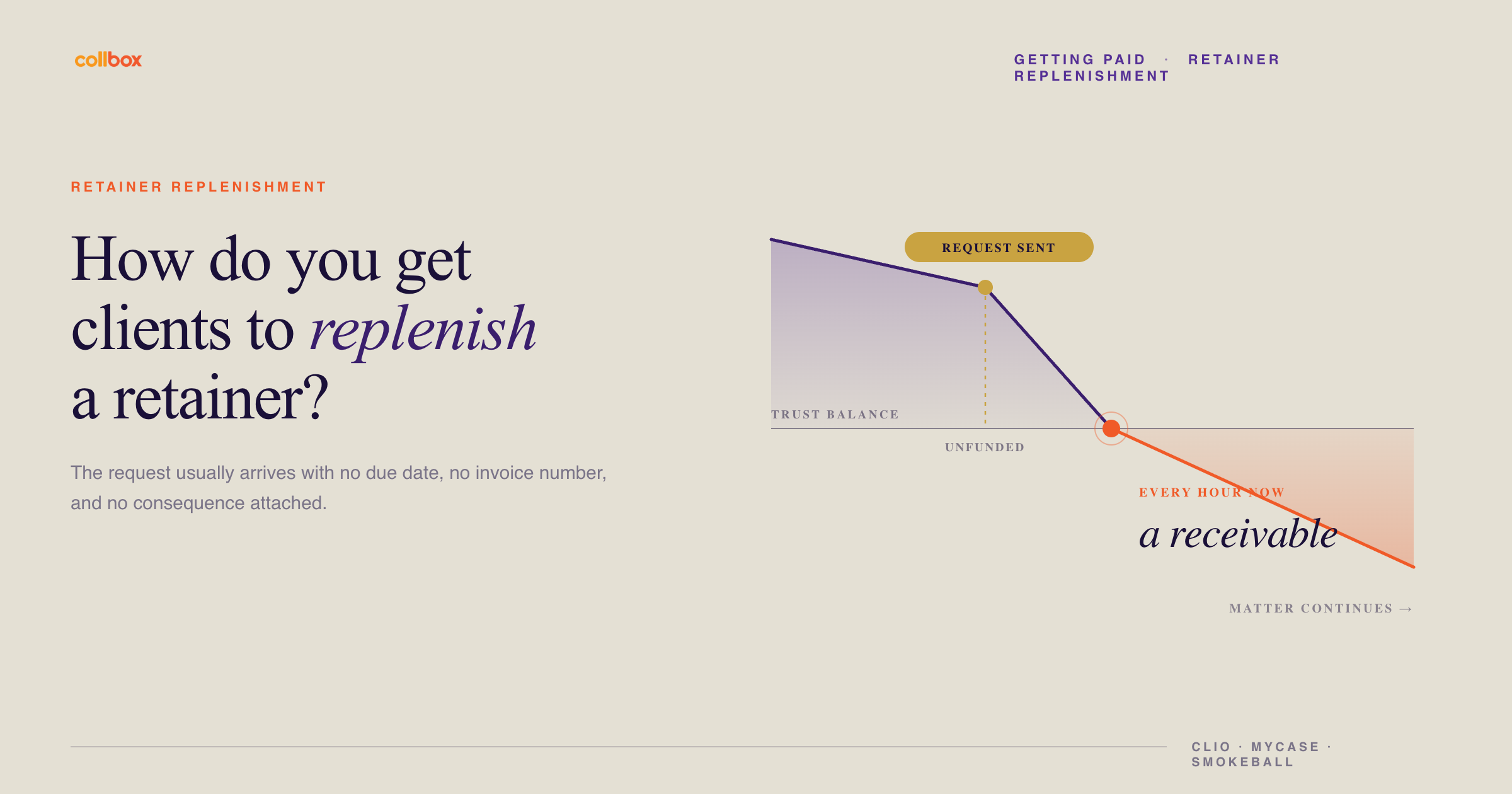
So the trust balance depletes to zero and legal services continue against nothing. Every hour billed from that point converts directly into a receivable. Three months later the firm has a client who owes real money, a matter still in progress, and no leverage at all, which is the least favorable position from which to start a collections conversation.
The retainer was supposed to prevent exactly this. It prevents it only if replenishment actually happens.
What should the replenishment trigger be set at?
Set it high enough that there is runway to collect before the balance runs out.
If your trigger is “when the retainer hits zero,” you have already lost, because collecting takes time and the work does not pause while you do it. A trigger at a meaningful percentage of the original deposit, or at a fixed dollar floor tied to your typical monthly billing on that matter type, gives you weeks of margin rather than none.
The number itself matters less than whether it is written down and automatic. Evergreen retainer settings in Clio, MyCase, and Smokeball can handle the trigger and the request. What they cannot handle is the client who receives the request and does nothing, which is where the process has to take over from the software.
Can you stop work if a client won’t replenish?
Sometimes, and it is more complicated than firms assume.
Withdrawal for nonpayment is permitted under Model Rule 1.16, but you cannot withdraw in a way that prejudices the client, and mid-matter withdrawal in active litigation raises both timing and confidentiality issues. Court approval is often required. This is not a lever you can pull quickly, which is precisely why it works poorly as a collections threat.
The more effective version is agreed in advance. A stop-work threshold discussed and documented at intake, before any money is at stake, is a shared understanding rather than an ultimatum. It also gives the client a reason to take the replenishment request seriously the first time, because they already know what it connects to.
For more on the ethical boundaries around collecting unpaid legal fees, see our guide on what the rules actually permit.
How do you set replenishment expectations at intake?
At intake you have something you will never have again, which is a client who wants you to take the case.
Use it. Walk through the replenishment mechanics explicitly. State the trigger amount, the expected turnaround, how the request will arrive, and what happens if it goes unfunded. Put it in the engagement agreement in language the client will actually parse.
Plain language matters more than firms think here. ABA Formal Opinion 505 advises using words like “advance” or “deposit for fees” rather than “retainer,” and explaining how and when the deposited sum will be applied to the balance owed. The word “retainer” carries connotations for clients that do not match what is happening, and a client who thinks they have paid for the case is a client who will be confused and resistant when asked for more.
Sizing matters too, and the standard advice is often wrong. As Matt put it on the same podcast:
“While coaching groups often advise doubling the retainer amount, pricing must depend on the clientele. For middle-class or lower-income clients, putting up large retainers—$10,000 to $50,000—is often not feasible, even if the case lifecycle costs that much. Attorneys serving these clients must find smart strategies to work around these limits.”
A retainer sized beyond what a client can fund does not produce a well-funded matter. It produces a client who agrees to a number they cannot meet and then cannot replenish it either.
Frequently asked questions
How often should a law firm request retainer replenishment? Tie it to a balance trigger rather than a calendar date, so the request arrives when the account genuinely needs funding. On active matters with steady billing that often works out to monthly, but the trigger should be the balance, not the date.
Should a replenishment request be sent as an invoice? Yes, in practice. Giving it an invoice number, a due date, and a payment link converts it from a notification into an obligation, and clients respond to that difference. Most practice management systems can generate it this way.
What do you do when a client repeatedly ignores replenishment requests? Treat it as an AR problem rather than an administrative one, which means consistent, escalating follow-up by someone whose job that is. Repeated silence on replenishment is usually the earliest reliable signal that a matter is heading toward a collections problem, and acting on it then is far easier than acting on it later.
Does evergreen retainer automation solve this? It solves the request, not the response. Automation reliably generates and sends the replenishment ask. Nothing in the software follows up with a client who receives it and does nothing, and that gap is where the receivable is created.
Should you stop work when a retainer is exhausted? Only where you can do so without prejudicing the client and consistent with your jurisdiction’s withdrawal rules. It works far better as a threshold agreed at intake than as a decision made under pressure mid-matter.
Stop replenishment failures from becoming receivables
If your firm runs on retainers and still carries meaningful accounts receivable, unfunded replenishment is usually where it came from.
Run your numbers through the CollBox AR Report Card, or schedule a conversation with our team to talk through where the gap is opening up.
