
Can a Law Firm Send a Client to Collections? What the Ethics Rules Actually Say

CollBox Team
Yes, a law firm can send a client to collections, but the ethics rules constrain how it is done in ways that matter more than most firms realize. The core limits come from your duty of confidentiality, which does not disappear when a client stops paying and cannot be sidestepped by handing the debt to someone else. You may generally disclose only what is reasonably necessary to recover the fee, you remain responsible for how a third party behaves on your behalf, and several states require you to offer fee arbitration before you can sue.
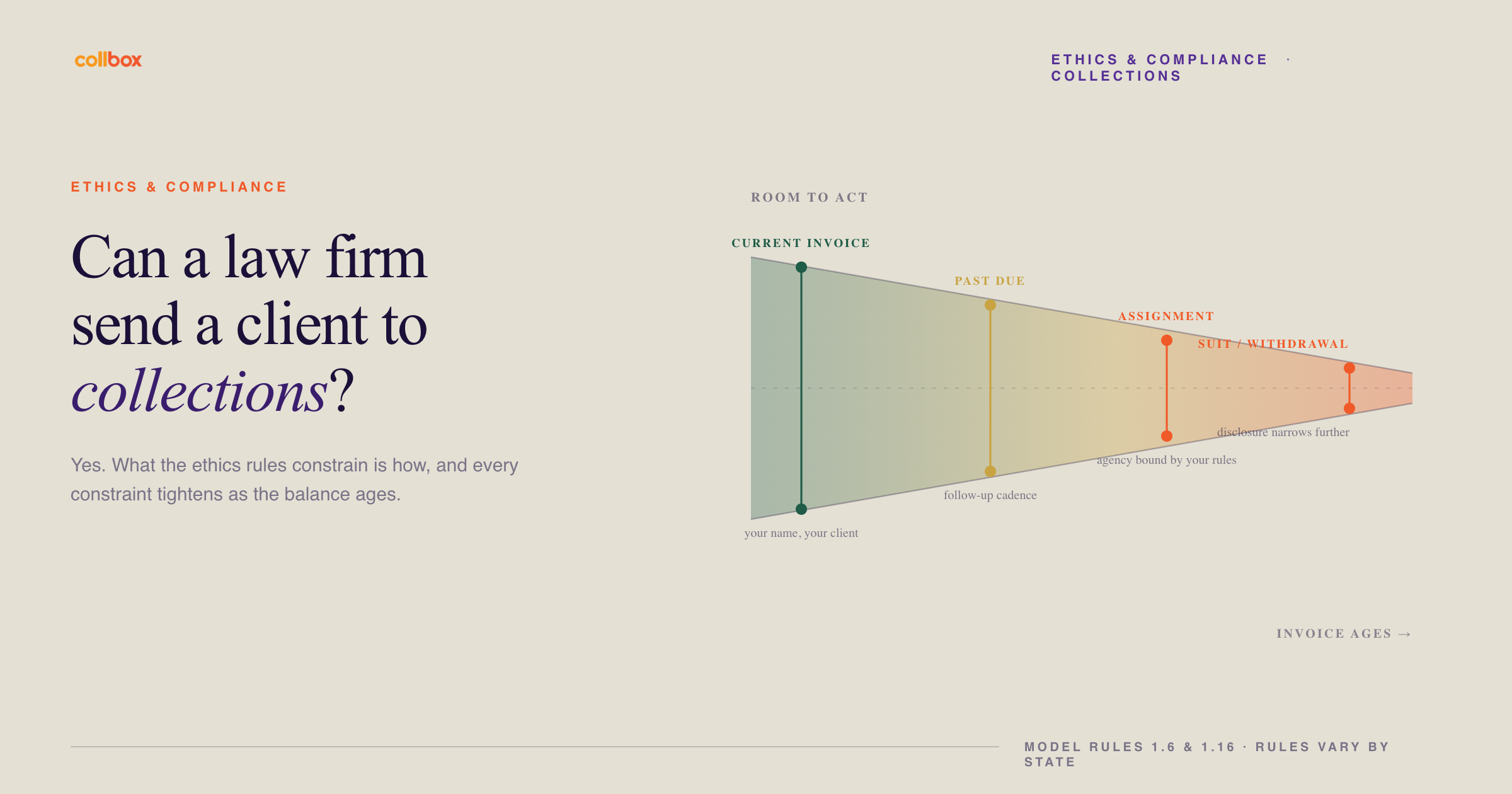
The practical takeaway is that the compliance-safe path and the financially smart path turn out to be the same path. Nearly every ethical constraint tightens as an invoice ages and the tactics escalate, which means the safest place to resolve an unpaid balance is early, in your firm’s own name, before anything needs to be assigned or litigated.
At CollBox, we work exclusively with small and mid-sized law firms on accounts receivable, with integrations into Clio, MyCase, and Smokeball. This question comes up on nearly every call we take, usually phrased as some version of “am I even allowed to do this?”
Does attorney-client confidentiality still apply to an unpaid bill?
It does, and this is where most firms get into trouble.
Model Rule 1.6 covers information relating to the representation regardless of where it came from. That includes a great deal of what would be useful to a collector. What the client owns, where they bank, what the matter was about, and what they told you in confidence about their finances.
There is a narrow self-defense exception permitting disclosure reasonably necessary to establish a fee claim. It is narrower than it sounds. California’s Formal Opinion 2022-1 concluded that a client’s asset and bank account information learned through the representation is generally confidential, that disclosing financial details relevant to collectability is usually not reasonably necessary to establish the claim, and that once judgment is entered the purpose behind the exception has been satisfied and it no longer applies at all.
Read that last part again, because it is counterintuitive. In California, the point at which you have won your fee claim is the point at which you lose the ability to use the client’s confidential financial information to collect on it.
Can you assign the debt to a collection agency and let them handle it?
Not as a way around the rules.
The D.C. Bar addressed this directly in Ethics Opinion 298. A lawyer may not avoid confidentiality duties by selling or assigning the debt to a collection agency and allowing that agency to bring suit in its own name. Disclosure to an agency is permitted only where the information is reasonably necessary to recover the debt and the lawyer secures a confidentiality commitment from the agency.
The broader principle underneath it is the one to remember. Where a third party is acting for your benefit on a client debt, their conduct is measured against the rules that bind you. Whatever an agency does in pursuit of your fee, you own.
This is worth sitting with before signing an agency contract. Traditional collection agencies are built for consumer and commercial debt, where the relationship is already over and the tactics reflect that. Those tactics are frequently a poor fit for a client who may return, who talks to other potential clients, and who has a bar complaint available as a response.
What about withdrawing from the matter for nonpayment?
Withdrawal for nonpayment is permitted under Rule 1.16, but the confidentiality problem follows you into the courtroom.
ABA Formal Opinion 476 addresses exactly this tension in civil litigation. A lawyer moving to withdraw has to give the court enough to rule on the motion while disclosing no more than reasonably necessary, and the guidance is to err toward non-disclosure when uncertain. Courts vary widely in how much detail they expect. Where a judge needs more, an in camera inquiry may be appropriate, though confidentiality obligations still apply in those off-the-record discussions.
Mid-matter withdrawal also carries its own risk of prejudicing the client, which is a separate obligation from the confidentiality question and a separate reason it works poorly as a collections lever.
Can you threaten to disclose confidences to get paid?
No, and this is the one that produces actual discipline.
Washington suspended a lawyer for six months after he threatened a client in a fee dispute by saying he would be forced to reveal client confidences in fee litigation. The reasoning is not subtle. Using the confidentiality obligation as leverage inverts the purpose of the rule.
The related failure mode is quieter and more common. In a fee dispute, the temptation is to raise everything difficult about the client, not just the facts establishing what is owed. That drift, from proving the fee to airing the grievance, is where firms cross the line.
Do you have to offer fee arbitration first?
In some jurisdictions, yes. California’s fee arbitration program is the best-known example, and a client can require the firm to arbitrate before the firm proceeds to suit. Other states have programs that are voluntary, or mandatory only in certain circumstances.
This varies enough that it cannot be generalized. Check your own jurisdiction’s rules before treating litigation as an available option, because in some states it is not the first one.
What is the compliance-safe way to collect unpaid legal fees?
Every constraint above gets tighter as the balance ages. Assignment, litigation, and withdrawal all raise confidentiality questions. Consistent professional follow-up on a current invoice raises almost none, because you are contacting your own client about your own bill using information they already have.
That points to a specific process. Follow up on a defined cadence starting well before an invoice is aged. Keep the outreach in the firm’s name so no third party is speaking for you. Document what was said and when. Agree the escalation path with the client at intake, so nothing that happens later is a surprise. And treat assignment to an agency as the exception, not the default endpoint.
“Every hard question about collections ethics is a question about what you’re allowed to do once a bill has gone bad. Almost none of them come up if the bill never gets there. That’s not a compliance argument, it’s just what the rules happen to reward.” Matt Darner, Co-founder and CEO, CollBox
CollBox is not a collection agency. We run consistent, professional follow-up on your outstanding invoices through your existing practice management system, in your firm’s name, with full visibility into every contact made. Our specialists are North American based and have worked as AR managers and clerks for large businesses, which is a different discipline from consumer debt collection.
Frequently asked questions
Can a lawyer sue a client for unpaid fees? Generally yes, though several states require fee arbitration to be offered or completed first, and in some the client can compel arbitration. Suing also raises the confidentiality questions above, since establishing your claim in a public filing means disclosing something about the representation. Check your jurisdiction’s requirements before treating suit as available.
Can I report an unpaid legal fee to a credit bureau? This is treated as a form of third-party disclosure and carries the same confidentiality analysis, with the added complication that credit reporting is regulated separately. Several jurisdictions view it skeptically. Get specific guidance before doing it.
Does the client’s file get held until they pay? Retaining lien rules vary substantially by state, and some jurisdictions restrict or prohibit it where withholding would prejudice the client. It is one of the most jurisdiction-dependent questions in this area.
Is using an outside AR service the same as using a collection agency? No. The distinction is what the third party does and how. An agency typically works aged debt with consumer-style tactics, often in its own name. A tech-enabled AR service runs follow-up on current and recently past-due invoices in the firm’s name, which keeps the activity much closer to what the firm would do itself.
Will professional follow-up damage the client relationship? Consistent, professional contact early tends to protect relationships rather than strain them, because the client is never surprised. What damages relationships is silence followed by escalation.
See where your receivables actually stand
Most firms asking whether they can send a client to collections are asking because a balance has already aged past the point of easy options. Before you get there, it helps to know what you are carrying.
Run your firm’s numbers through the CollBox AR Report Card, or schedule a conversation with our team to talk through your aging report.
