
When Should a Law Firm Write Off an Unpaid Invoice?

CollBox Team
A law firm should write off an unpaid invoice only after documented collection efforts have failed and there is no reasonable prospect of recovery, which is a much higher bar than most firms apply. The decision is usually made too early, for the wrong reason, and on a tax assumption that turns out to be false for most small firms.
Here is the part that surprises people. If your firm uses cash basis accounting, and most small law firms do, you generally cannot deduct an unpaid fee as bad debt at all. You never recognized the income, so you have no basis in the debt and nothing to deduct. Firms that clear out aged receivables at year end believing they are converting a loss into a tax benefit are, in most cases, converting it into nothing.
At CollBox, we work with small and mid-sized law firms on accounts receivable, and we see a lot of aging reports. The invoices firms are ready to abandon are frequently more collectible than they assume, and worth considerably more collected than written off.
Can a law firm deduct unpaid legal fees as bad debt?
It depends entirely on your accounting method, and the answer is worse than most firms expect.
Cash basis firms generally cannot. Under cash accounting you report income when you receive it. An unpaid invoice was never income, so writing it off produces no deduction. The IRS position here is consistent and firm: to deduct a bad debt, the amount must previously have been included in gross income. Service providers billing fees on a cash basis do not clear that bar.
Accrual basis firms generally can. Under accrual accounting you recognized the fee as income when earned, which means you have basis in the receivable and paid tax on money you never collected. If the debt becomes worthless, the deduction corrects that.
If this feels unfair to the cash basis firm, the logic is that both end up in the same place. The cash basis firm never paid tax on the uncollected fee. The accrual firm did, and the deduction refunds it. Neither gets an advantage. But the practical consequence for a small firm is real: writing off receivables at year end does not lower your tax bill, so whatever reason you had for doing it, tax was not it.
What does the IRS require before a debt counts as worthless?
More than firms typically have on file.
The debt has to be bona fide, meaning there was a genuine obligation to pay, backed by an engagement agreement, invoices, and a record of services performed. It has to be totally worthless in the year you deduct it, not merely old or inconvenient. And you have to show reasonable collection efforts.
Reasonable does not mean filing suit. It does mean more than two emails and a shrug. Documented calls, written notices, letters, and a log of attempts over time are what establish worthlessness if the deduction is ever questioned.
There is a partial-worthlessness option as well. If a client made partial payment before going dark, an accrual firm can deduct the unpaid portion in that year, or wait to see whether more comes in and take it later.
The documentation requirement creates an interesting loop. To justify the write-off, you need evidence of sustained collection effort. Firms that have that evidence usually have it because they built a real follow-up process, and firms with a real follow-up process have far fewer invoices reaching this point.
Is it better to write off an invoice or try to recover it?
Run the numbers once and the question mostly answers itself.
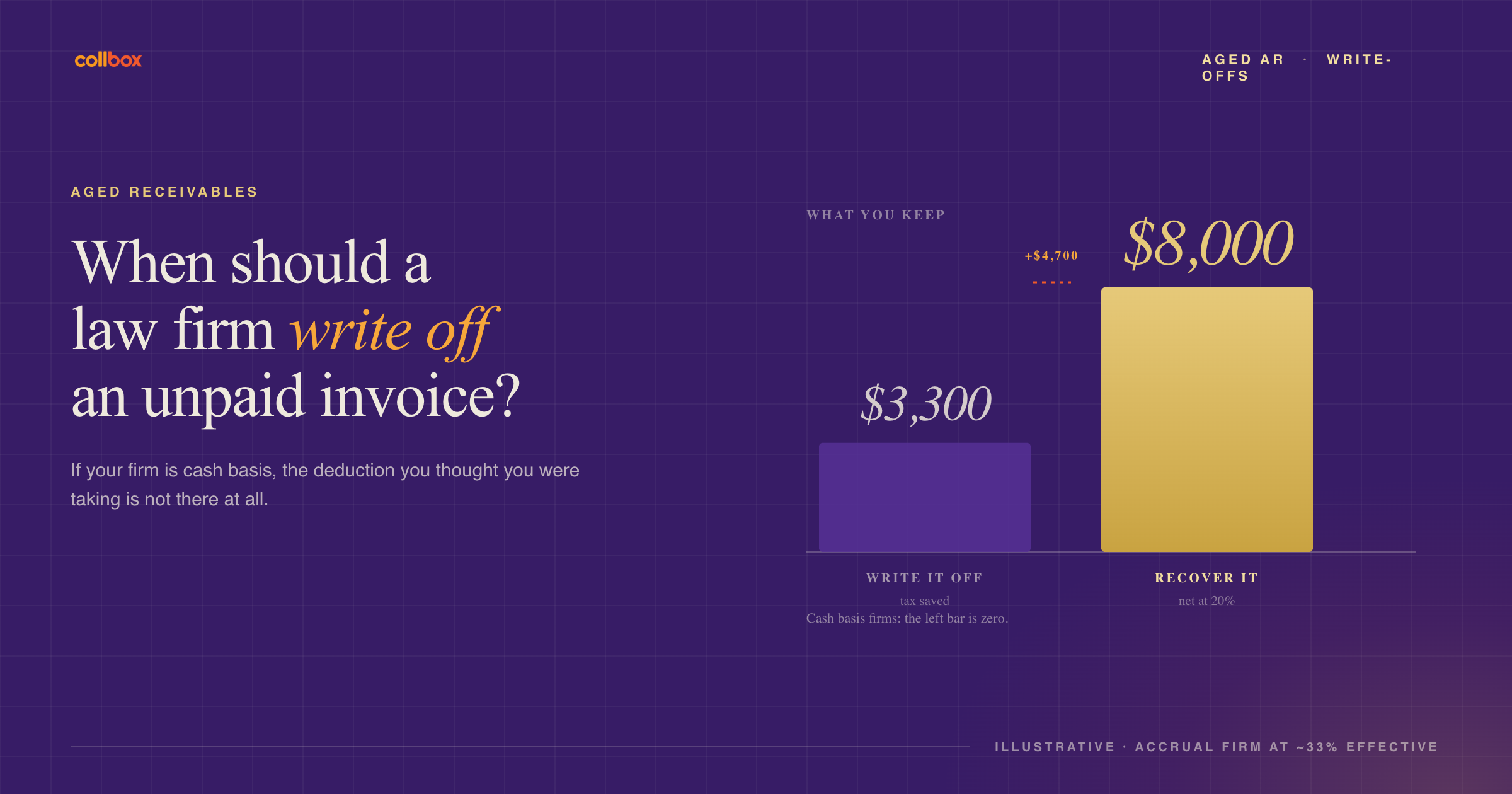
Take a $10,000 unpaid invoice at an accrual firm in roughly a 33% effective bracket. Writing it off saves about $3,300 in tax. Recovering it through a service charging a 20% contingency nets $8,000.
Recovery wins by nearly $4,700, and it wins even at fairly poor odds. At a 50% chance of recovery the expected value is still $4,000, which beats the guaranteed write-off. At cash basis firms the comparison is not close at all, because the write-off side of the ledger is zero.
Firms rarely make this comparison because writing off is not experienced as a financial decision. It is experienced as relief. “Write it off” is often what a firm says when it means “I would like to stop thinking about this.”
“Write-offs almost never get calculated, they get declared. Somebody looks at a number that’s been sitting there for a year, feels bad about it, and makes it disappear. Do the arithmetic even once and you find out you were about to give away four times what the tax deduction was worth, assuming you were even entitled to the deduction.” Matt Darner, Co-founder and CEO, CollBox
When is an invoice genuinely worth writing off?
Some are. The honest list is short.
The client is deceased with no estate, or has been through bankruptcy that discharged the obligation. The client cannot be located after real effort. The balance is small enough that pursuing it costs more than the amount. There is a genuine fee dispute you have evaluated and expect to lose. Or the applicable statute of limitations on the fee claim has run, which varies by state and is worth knowing for your jurisdiction.
What does not belong on that list: the client is annoying, the invoice is old, the matter ended badly, or nobody at the firm wants to make the call. Those are the reasons write-offs actually happen, and none of them are financial reasoning.
What should a firm do before writing anything off?
Sort the aging report before you decide anything. Balances at ninety days behave differently from balances at eighteen months, and treating them as one undifferentiated pile of “bad” is how collectible money gets discarded alongside genuinely dead accounts.
Then check whether each account actually received sustained follow-up, or whether it received two reminders and then silence. In our experience most aged balances fall into the second category, which means they were never really pursued. An invoice that was never worked is not an uncollectible invoice. It is an unworked one.
CollBox handles that follow-up for law firms through Clio, MyCase, and Smokeball, combining automated reminders with phone outreach from North American AR specialists. Firms frequently recover balances they had already mentally written off, which is precisely the outcome the arithmetic above predicts.
Frequently asked questions
Should a law firm write off unpaid invoices at year end? Year end is when firms tend to do it, largely out of habit and a desire for clean books. If your firm is cash basis there is no tax reason to time it that way, since there is no deduction either way. Make the decision based on collectibility, not the calendar.
How long should a law firm wait before writing off an invoice? There is no fixed period, and the more useful question is whether the account has actually been worked. An invoice at twelve months that received consistent professional follow-up and produced nothing is a different case from one at twelve months that received two automated reminders.
Does writing off an invoice mean I can never collect it? No. A write-off is an accounting and tax treatment, not a release of the debt. If an accrual firm later recovers an amount it deducted, that recovery is reported as income in the year received.
Can a law firm deduct costs advanced on behalf of a client? Often yes, even at cash basis firms, because those were actual out-of-pocket expenditures rather than unrecognized fee income. Separate advanced costs from unpaid fees when evaluating write-offs, since they are treated differently. Confirm the specifics with your CPA.
What documentation should we keep? Unpaid invoices, the engagement agreement, copies of all written collection notices, and a log of calls and attempts with dates. If the deduction is ever questioned, that record is what establishes reasonable effort and worthlessness.
Find out what your aged receivables are actually worth
Before writing anything off, it is worth knowing which balances have been genuinely worked and which have only been aged.
Run your numbers through the CollBox AR Report Card, or schedule a conversation with our team to walk through your aging report before year end.
