
When Should a Small Law Firm Outsource Accounts Receivable?

CollBox Team
Outsource accounts receivable when the follow-up work is real but the role is not full. Most small and mid-sized firms reach that point well before they can justify a dedicated hire, because an accounts receivable clerk in the United States costs roughly $50,000 to $60,000 a year in base salary and the collections work at a firm billing 20 to 200 clients a month does not fill a full-time seat. The decision is rarely about whether the work matters. It is about which of three structures gets it done consistently.
This guide compares those three structures and gives you a framework for choosing between them. If you are earlier in the process and still building the underlying system, start with our guide to law firm accounts receivable management and come back here once you know you need help.
What are the three ways a law firm can handle collections?
Every firm ends up in one of these, usually by drift rather than by decision.
Absorb it into existing roles. Someone already on staff adds past-due follow-up to their job. Usually a paralegal, a billing coordinator, an office manager, or the responsible attorney. No new cost, no new headcount.
Hire a dedicated person. A full-time or part-time accounts receivable specialist whose actual job is collections. Real capacity, real cost, real management overhead.
Use an outside receivables partner. A service that connects to your practice management system, runs the follow-up, and reports back. Fixed cost, no hiring, less direct control over day-to-day execution.
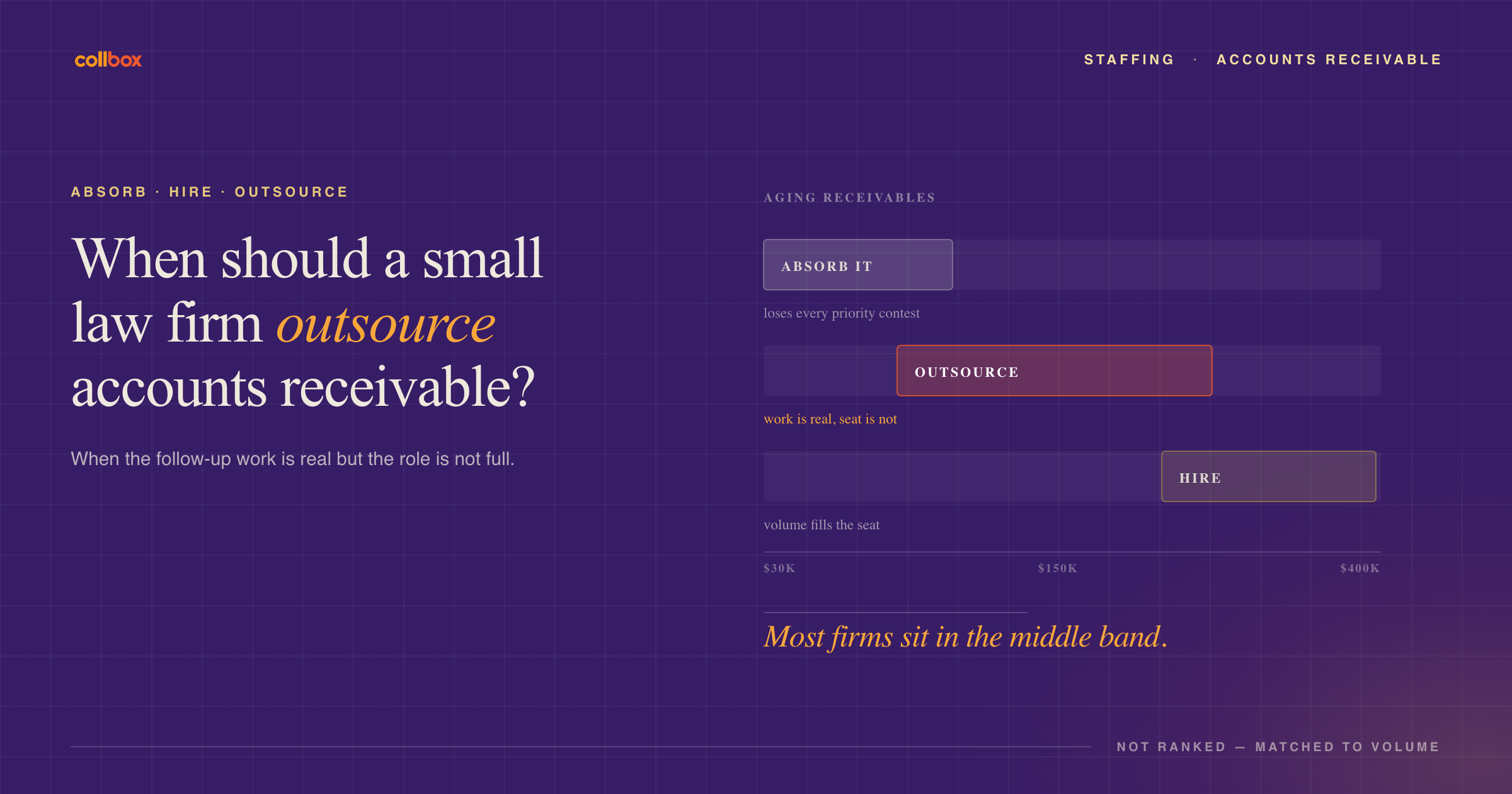
These are not ranked. A firm carrying $400,000 in aging receivables should probably hire. A firm carrying $30,000 should almost certainly not.
Why does absorbing collections into an existing role usually fail?
Because collections loses every priority contest it enters, and because the people most often assigned to it are the wrong fit temperamentally.
The priority problem is straightforward. Follow-up is uncomfortable and never urgent until it is a crisis, so it gets deferred behind billable work, court deadlines, and client communication. The cadence breaks during the first busy month and does not resume.
The fit problem is less obvious and does more damage. Speaking at 8am’s Integrations in Action webinar in August 2026, CollBox co-founder and CEO Matt Darner put it this way:
“Be careful if you’re having your billing coordinator make those calls. Someone who’s really good at getting bills out the door, being accurate and methodical, is often not the personality type that’s persuasive, thick-skinned, and willing to make a lot of dials and stay on top of things. Just think about who inside of your firm is that right personality type.”
A great billing coordinator is precise and process-driven. Those traits produce invoices clients cannot argue with. Collections rewards a different profile entirely: comfort with awkward conversations, tolerance for repeated refusal, and the persistence to make the eleventh call after ten went nowhere.
Assigning both to one person is not a training problem. It is a fit problem, and it resolves the way fit problems do. The invoices keep going out beautifully and the calls quietly stop.
When does hiring a dedicated AR person make sense?
When the volume genuinely supports the seat, and when you can afford the ramp.
Start with the fully loaded cost, not the salary. Add payroll taxes, benefits, software seats, and workspace to the $50,000 to $60,000 base. Then add the costs that never make the budget conversation: weeks of hiring, training on your practice management system, the ramp before productivity, and the risk of turnover inside two years.
Against that, ask what the role would recover in a year. If your aging is large enough that consistent follow-up recovers a multiple of the fully loaded cost, hiring is a sound decision and gives you control an outside partner cannot match.
The failure mode is hiring for a role that is one-third collections and two-thirds general administration. That is an admin hire wearing a collections title, and it recreates the priority problem you were trying to solve.
When does an outside receivables partner make sense?
When the work needs to happen consistently but does not justify a seat, and when you want the reporting without building it.
This is where CollBox sits. CollBox is a tech-enabled accounts receivable service built for small and mid-sized law firms, integrating directly with Clio, MyCase, and Smokeball. Invoices sync automatically, past-due balances are detected without anyone flagging them, and a dedicated North America-based accounts receivable specialist runs the email and phone follow-up on your firm’s behalf.
You can see how dedicated receivables support works in more detail, but the structural points that matter for this comparison are these.
The pricing is a flat monthly subscription rather than a percentage of recovery, so your cost is predictable and you keep the full amount collected. Payments run through the methods you already use, including LawPay. You choose who gets contacted and can exclude individual clients, VIPs, or entire practice areas. Every call, email, and note is logged in one timeline.
One scope limit to know before you evaluate. CollBox works balances that are 180 days past due and newer, operating in a first-party capacity on your firm’s behalf. Older balances fall outside that window and belong on a different path, which the matrix below addresses directly.
How do you choose between the three?
Work through these six factors. The right answer is usually obvious once you have scored four or five of them in the same direction.
| Factor | Absorb into existing roles | Hire dedicated staff | Outside receivables partner |
|---|---|---|---|
| Staff capacity | Works only if someone has genuine open hours and the right temperament. Rare. | Right answer when there is enough sustained volume to fill a real seat. | Best fit when the work is consistent but does not fill a role. |
| Overdue balance size | Viable at small balances where a few reminders resolve most of it. | Justifiable when aging is large enough that recovery clears fully loaded cost by a wide margin. | Strong across the middle range, where the balance is meaningful but the seat is not. |
| Client relationship sensitivity | Highest risk. Attorneys asking their own clients for money strains the relationship both ways. | Good if you hire well. The person becomes a known, neutral point of contact. | Good. A trained specialist who is not the attorney removes the relationship from the conversation. |
| Practice management system access | Manual. Someone pulls reports and tracks status by hand. | Depends on the hire’s fluency with your system and the reports you build. | Direct integration with Clio, MyCase, or Smokeball. No manual pull, no lag. |
| Reporting and visibility | Usually a spreadsheet, if anything. Firms rarely know what was said or when. | As good as the process you build and enforce. | Built in. Full timeline of calls, emails, notes, and payment progress. |
| One-time cleanup vs. ongoing | Neither, in practice. Sporadic effort produces sporadic results. | Ongoing. A hire is a permanent structure and a poor fit for a one-time cleanup. | Ongoing, within the 180-day window. Genuine bad debt cleanup belongs with a licensed collection agency instead. |
That last row is the one firms get wrong most often. Most practices only start shopping for help once a mountain of aged balances has accumulated, and they evaluate every option against the oldest, hardest paper on the books. That is the wrong test. Judge each option on how well it keeps receivables from aging in the first place, and route genuinely old balances separately.
What should you ask a receivables partner before signing?
Five questions that surface the real differences.
What is your scope? Ask specifically which balance ages a provider will and will not work, and whether they operate as a first-party service on your behalf or as a third-party collection agency. These are meaningfully different arrangements with different implications for your client relationships.
How do you charge? Flat subscription and contingency percentage produce very different economics as recovery grows. Understand which one you are buying.
Who actually makes the calls? Ask whether you get a consistent assigned person or a rotating pool, where that person is based, and what accounts receivable training they have.
What will I be able to see? You should be able to answer “what happened with this client” without emailing anyone. If the reporting is a monthly summary, that is a gap.
What happens when someone will not pay? Recovery is only half the job. As Matt described the CollBox approach on the same webinar, the goal when a client is not going to pay is to find out why and route it to the right person at the firm quickly, whether that is a service issue, a clerical error, or a genuine dispute. A partner who only reports non-payment is leaving the useful information on the table.
For what consistent follow-up produces in practice, see our law-firm recovery results.
Frequently asked questions
Is it cheaper to outsource accounts receivable or hire someone? For most small and mid-sized firms, outsourcing costs less because the collections work does not fill a full-time seat. A dedicated accounts receivable clerk runs roughly $50,000 to $60,000 a year in base salary before benefits, software, and hiring costs. Firms with large enough aging to keep a specialist genuinely busy can make the hire pencil out.
Will outsourcing collections damage my client relationships? It depends entirely on execution. Professional, consistent follow-up from a trained specialist who resends invoices and answers payment questions is typically a better client experience than sporadic, uncomfortable calls from the attorney handling the matter. Firms using CollBox choose exactly who is contacted and can hold back VIP clients or entire practice areas.
Is an outsourced AR service the same as a collection agency? No. A collection agency generally works on contingency, takes a percentage of recovery, and is built for balances that have already gone bad. An outsourced accounts receivable service like CollBox works on a flat subscription in a first-party capacity, handling routine follow-up much earlier while the client relationship is intact and the balance is still highly collectible.
How old can a past-due balance be before outsourcing stops helping? CollBox works balances 180 days past due and newer. Beyond that window, recovery odds drop sharply and the appropriate path is a licensed collection agency rather than a receivables service. If most of your aging sits past 180 days, solve that separately and then put a process in place so it does not happen again.
Do I need to change how my firm bills to use an outside partner? No. A receivables partner should connect to the system you already use and work from the invoices you already send. CollBox integrates directly with Clio, MyCase, and Smokeball and uses your existing payment methods, including LawPay.
Work out which structure fits your firm
The comparison above narrows it quickly, but your aging report answers it definitively. Schedule a conversation with Matt Darner to walk through what your current balances would realistically recover under each approach, or get started with CollBox.
