
What Family Law Firms Learned at 8am’s Integrations in Action Webinar

CollBox Team
On August 26, CollBox joined the final session of 8am’s Integrations in Action series, hosted by Amanda Connolly, Senior Partner Account Manager at 8am. The session was built for MyCase customers and focused on one question: where does a small family law firm actually lose time and money, and which integrations close those gaps? Four partners each covered the problem they solve, how their MyCase integration works, and what firms see afterward.
Here is what came out of it.
The through-line: nobody went to law school to do admin work
Two different presenters made the same point independently, which is usually a sign the point is real.
Matt Darner opened the CollBox segment with it directly. No one went to law school or joined a law firm to be a bill collector. Alex Drake, COO at Tempello, said nearly the same thing twenty minutes later about time entry.
That is the actual theme of the session. None of the four tools on the screen replace legal judgment. All four remove work that has attached itself to legal judgment by default, usually because there was no one else to hand it to. Form population. Past-due follow-up. Answering the phone. Logging a four-minute email.
Each of those is real work. None of it is the work a firm sells.
CaseForm: the same facts, entered once
CaseForm connects MyCase matter data to court forms. The pitch was that the information needed for a filing packet already exists inside the matter. Parties, children, income, supporting documents. In family law especially, the same facts repeat across a packet, so staff re-enter the same data across several forms.
CaseForm pulls the matter data and documents from MyCase, generates a first draft of the selected forms, lets the user review and edit, and saves the completed packet back to the matter.
The library currently covers more than 7,000 court forms across California, Florida, New York, Texas, and Alabama, including county-level forms rather than statewide forms only. The demo filled a California schedule of assets and debts from three uploaded bank statements, including the arithmetic and the totals. Pricing is $49 per seat per month with a 14-day trial.
CollBox: what happens after the bill goes out
Matt covered the segment on collections. The framing was a staffing problem before it was a software problem.
Someone at the firm has to chase past-due invoices. At most small and mid-sized firms, that someone is an attorney who should be doing higher-value work, or an admin, billing assistant, or paralegal who has no accounts receivable training and no real appetite for the task. So the follow-up happens inconsistently, or it does not happen at all.
CollBox integrates directly with MyCase, syncs invoices, detects past-due automatically, and runs the follow-up. That runs in two layers. Automated intelligent reminders with time-based escalating language and resent invoices with live payment links, fully compatible with LawPay. And a dedicated, North America-based accounts receivable specialist who makes the phone calls. The same person every time, so they know how the firm wants to be represented.
The default cadence Matt described as best practice for most law firms is weekly email reminders paired with biweekly outbound phone calls, with dynamic follow-up layered on top. Client says they never got the bill, CollBox resends it. Client asks how to pay, CollBox walks them through the firm’s payment instructions. Client asks for a callback next Tuesday, CollBox calls next Tuesday.
When a client is not going to pay, the job shifts to finding out why and routing it to the right person at the firm quickly. Service issue, clerical error, or genuine dispute. Firms keep full control over who gets contacted, and can exclude individual clients or entire practice areas from outreach.
Two numbers Matt put on the screen. Once an invoice ages past 90 days, which is common, as much as 47% of its collectibility can be gone. And firms working with CollBox get paid an average of 40% faster.
On cost, the comparison was to hiring. An accounts receivable clerk in the United States runs roughly $50,000 to $60,000 a year. CollBox is a flat monthly subscription with no contingency fee and no percentage of what is recovered, so firms keep 100% of collections and use the payment methods they already have.
Ruby: answering before the caller gives up
Ellie Miller, Manager of Partnerships at Ruby, made the case that in family law the first call often arrives at the worst moment of a client’s life and cannot go to voicemail.
Ruby is a live virtual receptionist service staffed by people in the United States, available 24/7/365 in English and Spanish. Not bots. Average answer time is under ten seconds, which matters because the first firm to answer is usually the firm that books the client.
Beyond answering, Ruby handles customized intake, quotes consultation fees, and schedules consultations on the same call. Ruby customers gain an average of ten or more hours back in their schedules, and 90% capture more billable hours than the national average for attorneys.
Ellie also previewed a deeper MyCase integration launching this year that moves past syncing call data into taking actions inside MyCase: creating clients, creating and updating cases, and booking appointments directly onto the firm’s calendar. Ruby also handles outbound calls, including document collection reminders, appointment confirmations, and re-engaging consults that never retained.
Tempello: the time that never makes it to an invoice
The premise is that roughly 80% of a firm’s daily work runs through email, most of it is billable, and almost none of it gets logged in the moment.
His framing was sharp. A four-minute email answered between hearings is real legal work that disappears. At $500 an hour, a 0.1 is worth $50, and attorneys skip it constantly because logging it interrupts the work. Friday afternoon timekeeping is guesswork, and guesswork gets rounded down. Entries written from memory come out vague, and vague entries invite client pushback.
He also made the point that matters directly to family law: firms billing against evergreen retainers never draw down trust on time that was never logged.
Tempello uses AI to identify billable emails, match them to the right MyCase matter, draft narrative time entries, and save the email body and attachments into the matter automatically. Setup takes about ten minutes and runs in the background across every device. Firms typically see billables increase 20% to 30%. Pricing is $0.49 per matched email, usage-based, with a seven-day free trial. Unmatched emails are not charged.
What to do with this
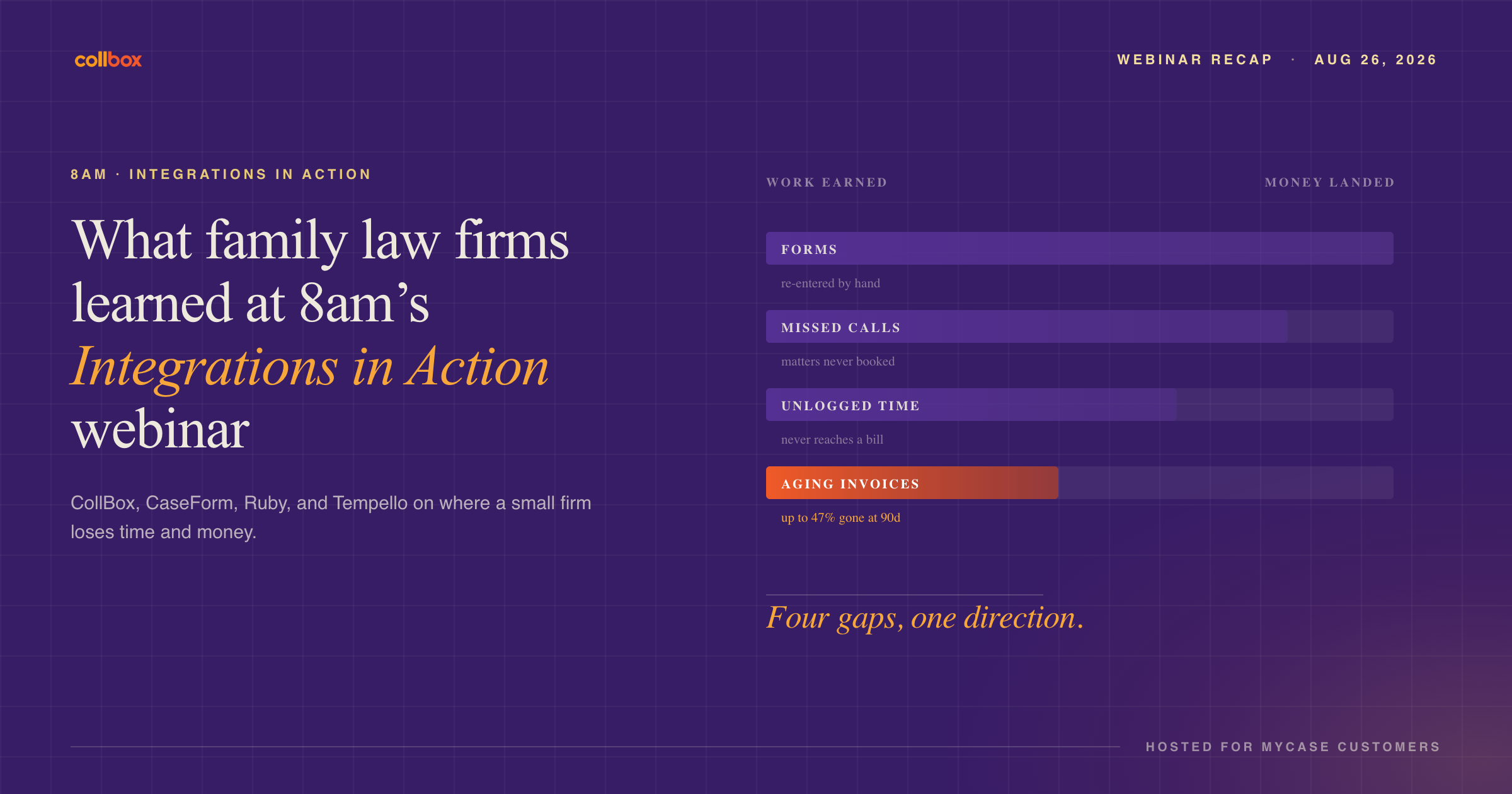
The four gaps covered in the session compound in the same direction. Forms eat staff hours. Missed calls cost matters. Unlogged time never reaches an invoice. Invoices that do go out age until they are worth a fraction of face value.
If a firm can only take on one of these right now, the useful test is which gap is costing the most money that has already been earned. Unbilled time and uncollected invoices both fall into that category, and both are cheaper to fix than they look.
Thank you to Amanda and the 8am team for the invitation, and to CaseForm, Ruby, and Tempello for a genuinely useful hour.
Frequently asked questions
Does CollBox work with MyCase? Yes. CollBox integrates directly with MyCase, syncing invoices and client contact information and detecting past-due balances automatically. CollBox also integrates with Clio and Smokeball.
Does CollBox take a percentage of what it recovers? No. CollBox charges a flat monthly subscription rather than a contingency fee, so the firm keeps 100% of what is collected and payments run through the firm’s existing methods, including LawPay.
How quickly does an unpaid legal invoice lose value? Collectibility drops sharply with age. Based on CollBox recovery data, an invoice that reaches 90 days past due can lose as much as 47% of its collectibility, which is why the follow-up cadence in the first 90 days matters more than the effort that comes after.
Can a firm control which clients get contacted? Yes. Firms can exclude specific clients, VIPs, or entire practice areas from outreach, and see every call, email, and note logged in a single timeline.
See what your past-due invoices are actually worth
If the collections segment was the one that landed, the next step is a short conversation about your aging. Schedule a consultation with the team or see how CollBox works.
