
Do Payment Plans Actually Help Law Firms Get Paid?

CollBox Team
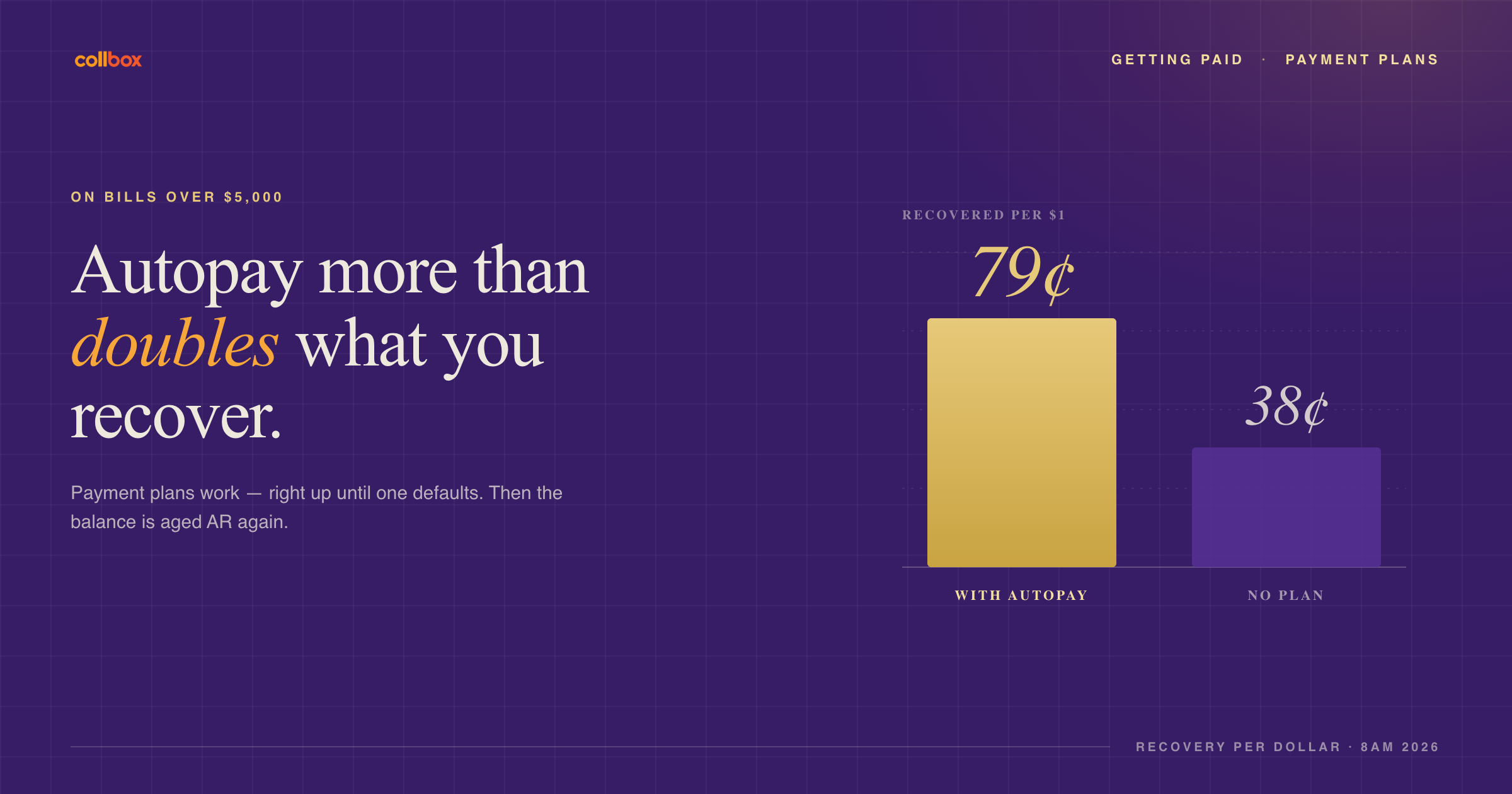
Yes, payment plans meaningfully improve collections, especially on larger bills, but only up to the point where a client keeps paying. 8am’s 2026 data found that on invoices over $5,000, autopay plans recovered about 79 cents on the dollar, compared to just 38 cents for large bills with no plan attached. That is more than double the recovery on exactly the kind of balance that otherwise ages into a write-off. Client demand backs it up too: Clio’s 2026 research found that 71% of clients prefer fixed or flat fees, a sign that predictable, structured payment terms match how clients actually want to pay.
The catch is that a payment plan only works while the payments keep coming. When a plan defaults, you are back to aged AR, and that is where firms need a second layer.
Why do payment plans improve collection rates?
Payment plans work because they lower the single biggest barrier to paying a large legal bill: the size of the ask.
A $6,000 invoice due in full is easy to defer, dispute, or avoid. The same $6,000 split into six automated monthly payments feels manageable, and autopay removes the friction of the client having to act each month. The 8am numbers show the effect directly, with autopay more than doubling recovery on large balances.
There is a second benefit that is easy to overlook. A plan converts an awkward one-time collection conversation into a routine, pre-agreed arrangement. Nobody at the firm has to call and ask for money, because the terms were set at the start and the payments run on their own.
When do payment plans stop working?
A payment plan is only as good as the client’s willingness to keep paying it. Plans default. Cards expire. Clients hit their own financial trouble and go quiet.
This matters more in 2026 than it used to, because the balances at stake are growing. According to 8am, the average overdue balance rose 21% between 2024 and 2026, from roughly $2,800 to $3,400, and the median overdue bill now sits 131 days past due. A defaulted plan on a large matter does not become a small problem. It becomes a large, aging one.
At that point, the tools that set up the plan cannot recover it. Autopay does not chase a failed payment. A reminder email does not restart a plan the client has abandoned. What recovers a defaulted balance is the same thing that recovers any aged invoice: consistent, professional human follow-up with a real escalation path.
How should a firm handle the balances a plan cannot recover?
Set the plans up well, then have a process ready for the ones that fail.
Offer structured payment options, especially autopay, on any large balance. Set the terms at intake so payment expectations are clear before there is a problem. And when a plan defaults, escalate quickly rather than letting the balance drift for another 90 days.
That last step is where most firms fall down, and it is the specific gap CollBox fills. CollBox is a tech-enabled accounts receivable service built for small and mid-sized law firms, integrating with Clio, MyCase, and Smokeball. When a payment plan defaults or a large balance goes past due, a real person runs a consistent follow-up cadence to recover it, so a broken plan does not quietly turn into a write-off. To date, CollBox has recovered more than $140 million for law firms.
“Payment plans are one of the best tools a firm has, and the data is clear that they work. But firms treat the plan like the finish line, when really it is the starting line. The plan gets you most of the way on the clients who keep paying. Someone still has to handle the ones who stop, and that is not a job you can automate away.” Matt Darner, Co-founder and CEO, CollBox
Frequently asked questions
Do payment plans really help law firms get paid? Yes, particularly on larger invoices. 8am’s 2026 data found autopay plans recovered about 79 cents on the dollar on bills over $5,000, versus 38 cents with no plan. Plans lower the barrier to paying a big bill and remove the need for repeated collection conversations.
Should a law firm offer autopay? For larger balances, the data strongly favors it. Autopay more than doubled recovery on bills over $5,000 in the 8am dataset, largely because it removes the monthly friction of the client having to actively make each payment.
What happens when a client’s payment plan defaults? The balance reverts to aged accounts receivable, which is harder to collect the longer it sits. The tools that set up the plan, autopay and reminders, cannot recover a plan the client has abandoned. That requires human follow-up, which is where a service like CollBox comes in.
Are payment plans worth it for smaller invoices? The strongest, clearest data is on balances over $5,000, where the recovery gap is largest. Smaller invoices often collect fine through standard terms and online payment, so plans deliver the most value on the larger bills that are most likely to age or be disputed.
Set up plans that actually get paid
Payment plans are a strong first move, and a real recovery process is the backup that makes them safe. See how CollBox works or schedule a conversation with the team to talk through both sides of getting large balances paid.
