
How Do You Follow Up on Past-Due Invoices Without Damaging Client Relationships?

CollBox Team
You follow up consistently, framed as client service rather than a chase, on a documented cadence, and always with a legitimate reason for the outreach. Done this way, following up protects the client relationship instead of straining it, because it reads as attentiveness rather than pressure. CollBox built its entire approach around this idea, adding structured, friendly, relentless follow-up on behalf of law firms without the aggression clients dread.
Why does aggressive collections backfire?
Because aggression is not actually what gets you paid, and it costs you the relationship on the way.
CollBox co-founder Matt Darner is emphatic that recovering money does not require being the stereotype. “No baseball bats,” as he jokes. What works is being first in line. When a client sits down to pay their bills, and they always have many, you want to be at the top of the mental list, not the loudest voice threatening them. You earn that spot with timely, friendly, consistent reminders, not volume or hostility.
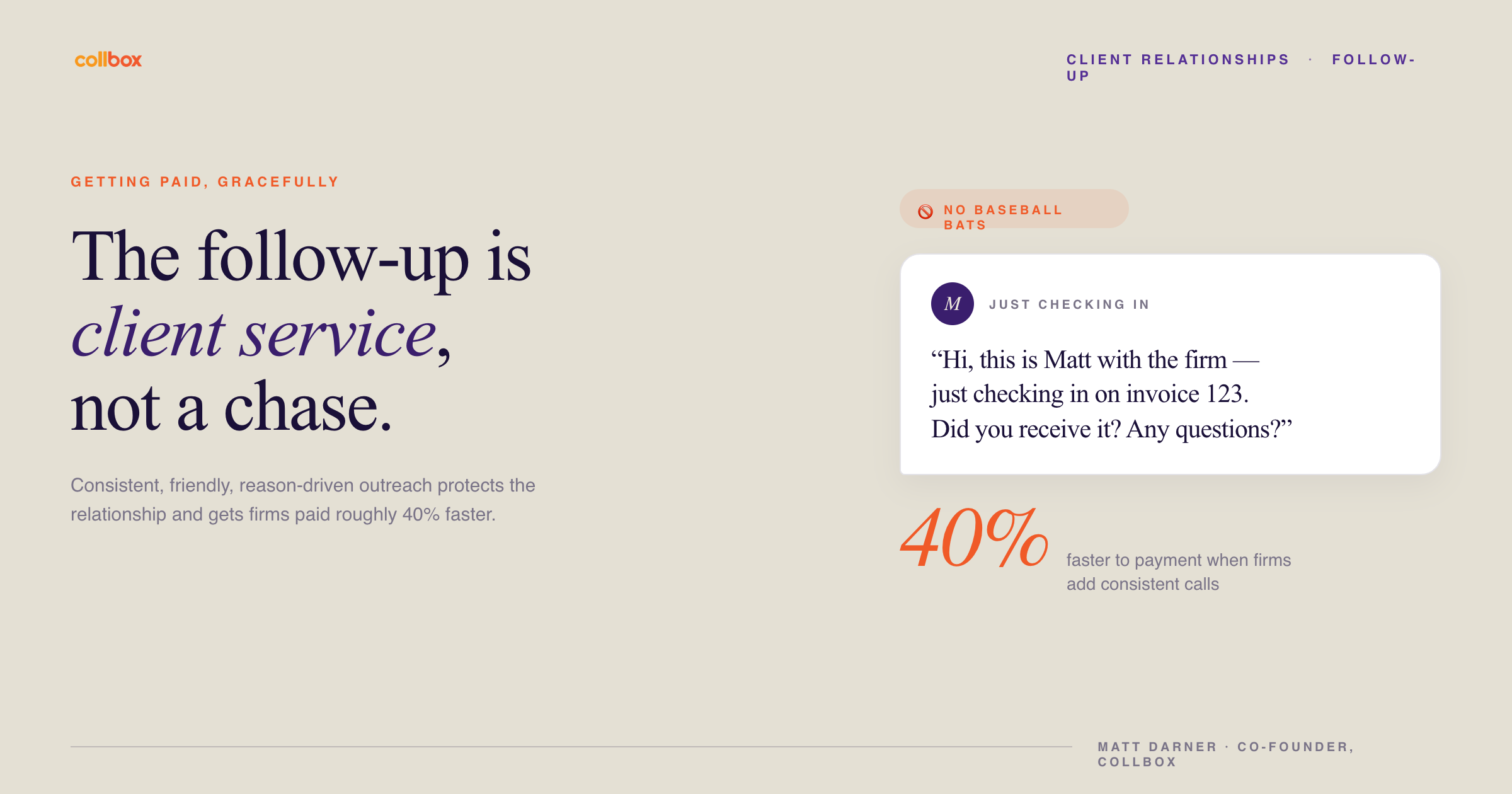
The reframe that makes this work is treating collections as client service. Instead of a chase, Matt approaches each touch as a check-in: “Hi, this is Matt with the firm, just checking in on invoice 123. Did you receive it? Any questions?” That single shift changes the emotional tenor of the interaction and often surfaces the real reason a bill is unpaid.
What is actually behind most unpaid invoices?
Often it is not refusal. It is confusion, silence, or a missed invoice. Collections ranks as a major hurdle for 68% of attorneys in the 8am Legal Industry Report, yet much of that difficulty comes down to process rather than genuinely unwilling clients.
The number one excuse is “I never got the invoice,” which is sometimes true and usually the first thing a friendly call resolves. Underneath that, a lot of nonpayment traces back to a communication gap. Poor client communication is one of the largest sources of bar complaints and one of the largest reasons clients withhold payment. When a client is unsure how their matter is going, they hesitate to pay for it.
This is why Matt treats each follow-up as a chance to take the client’s temperature. A well-timed call is not just about the money. It is an opening to clear up a clerical mix-up, answer a question about the case, or reassure a client who has gone quiet.
What cadence should you follow?
A rhythm that is persistent without being overwhelming.
With the average firm taking 43 days to collect after billing, per Clio’s Legal Trends Report, a real cadence is what beats that average. Matt’s default is weekly email reminders paired with biweekly phone calls, every other week on the calls. That is frequent enough to break through, and spaced enough to avoid blowing up someone’s phone and inviting a complaint. Email and text are easy to ignore or delete. A friendly, gentle, repeated phone call is much harder to brush aside, and eventually the client decides to just deal with it.
The payoff is measurable. Firms that add consistent phone calls to their follow-up get paid roughly 40% faster on average, based on CollBox’s data, which pulls real time out of their lockup. Matt shares that figure not to sell the calls but to empower firms to make them, because the phone is the piece most firms skip.
How do you give every follow-up a reason?
You attach the outreach to a logical moment, so it never feels like a bare demand for money.
This is a trick Matt carries over from sales: always have a reason for the next call. End of month, end of quarter, mid-year, or year-end book closeouts all work beautifully. “We’re closing out our books and I noticed this was still open, can we work out a plan to close it out?” lands very differently from “just checking if you’re going to pay.” The reason gives the client a why, and it lets you pair the ask with a small, positive incentive.
Early-pay discounts are the friendliest version of this. Before an invoice is even past due, you can offer to shave a few percentage points if the client resolves it within a set window, always with a grateful tone: thank you for being a great client, this helps us out. The same gentle time pressure works on past-due balances too.
When is it time to think about leverage?
Before your leverage disappears, which happens the moment the matter is finished.
Your best leverage is the excellent work you are doing and your ability to pause it or withdraw if a bill goes unanswered. Matt’s core warning is that once the case is over, that leverage is gone, and you are left trying to invent it through discounts, collection agencies, or lawsuits. He describes how an hourly matter can flip from a modest retainer balance to a five-figure loss overnight when a firm waits too long to act.
So map your leverage points against a rough timeline for each matter type. Use your follow-up cadence to remove every clerical doubt and invite the client to raise any problem, and know the point at which continuing to work without payment stops making sense. Acting on leverage is not aggression. It is the professional boundary that keeps a firm sustainable. Any escalation beyond that, such as a collection agency or filing suit, should always be checked against your bar rules first. For how this fits into a complete AR process, see CollBox’s guide to law firm accounts receivable management.
Frequently asked questions
How often is too often to follow up? Daily contact tips into harassment and can invite a bar complaint. Matt’s weekly-email, biweekly-call cadence keeps you persistent and present without crossing that line. The goal is to be consistent, not constant.
What do I say on a collections call so it does not feel awkward? Open as client service, not confrontation: confirm they received the invoice, ask if they have questions, and offer to help resolve anything unclear. Attaching a reason, such as a month-end or quarter-end closeout, makes the call feel natural rather than pointed.
Do early-pay discounts train clients to expect discounts? Used sparingly and framed as a thank-you tied to a short window, they accelerate payment without becoming an expectation. The key is that the discount is a small, positive incentive for speed, not a default you lead with.
What if the client says chasing them will hurt the relationship? That worry usually comes from the attorney, not the client. Delegating follow-up to someone removed from the legal work, and keeping the tone professional and friendly, preserves the relationship while still recovering the money.
How does CollBox keep follow-up from feeling aggressive? CollBox runs the client-service cadence on the firm’s behalf, including the phone calls, with a friendly and consistent tone inside the firm’s existing tools. Firms get faster payment without becoming the bad guy in the relationship.
Get the follow-up handled
If your firm knows it should be calling and following up but never quite gets to it, that gap is exactly what CollBox fills. Book a short call
