
Can Clio Collect Your Law Firm’s Unpaid Invoices?

CollBox Team
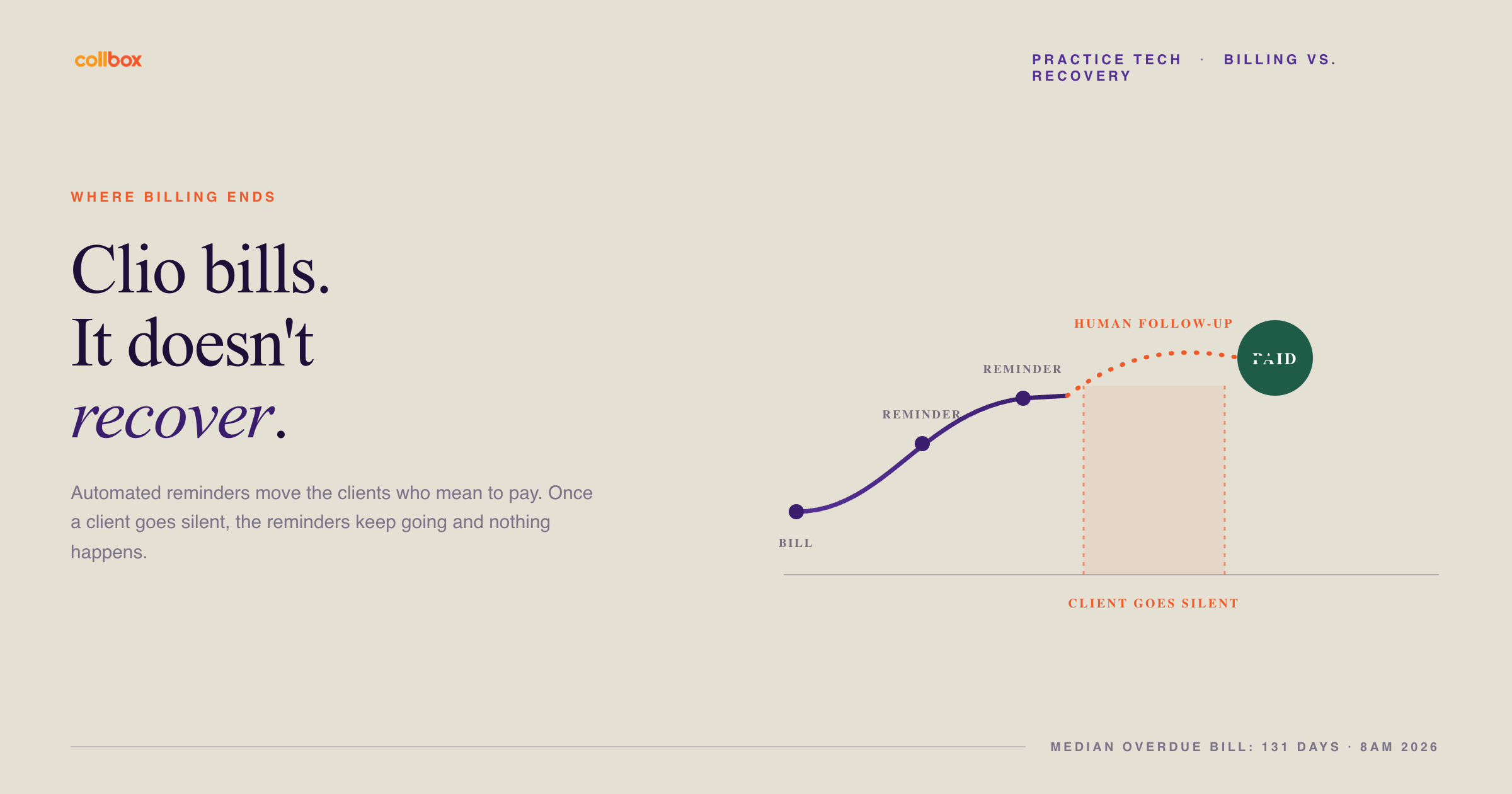
Clio can bill, send invoices, take online payments, and automate payment reminders, and doing all of that well genuinely improves how fast your firm gets paid. What Clio does not do is actively recover the invoices that go unpaid anyway. Automated reminders keep going out, but no one inside the software picks up the phone when a client stops responding at 60 or 90 days. That gap, between billing and actual recovery, is where most law firm accounts receivable quietly ages.
Understanding exactly where Clio’s capabilities end helps you decide what to add on top, rather than assuming your practice management platform already has your collections covered.
What does Clio handle in the collections process?
Clio is strong at the front end of getting paid, and firms should use every piece of it.
Clio Manage handles time tracking and invoicing, so bills go out accurately and on time. Clio Payments and integrated payment tools let clients pay online, which matters more than almost any other single lever. 8am’s 2026 data found that firms accepting online payments collect roughly 4.5 times faster than firms relying on print billing. And Clio’s automated reminders keep gentle pressure on outstanding invoices without anyone lifting a finger.
For invoices a client intends to pay, this stack works. The client gets a clear bill, a payment link, and a nudge or two, and the money arrives.
Where does Clio’s collections capability stop?
Automation handles the willing. It does not handle the silent.
An automated reminder assumes someone is reading it and deciding not to act yet. Once a client stops engaging entirely, more reminders into the same inbox change nothing. According to 8am’s July 2026 analysis of millions of small-firm invoices, the median overdue bill is now 131 days past due. A payment reminder is not what moves a bill that has been sitting for four months. Human follow-up is, with a real person, a real conversation, and a real escalation path.
There is also a workflow cost to bolting a separate collections effort onto your practice management system. Clio’s own research has highlighted how much time firms lose moving between disconnected tools. Clio’s 2026 data found that the average firm spends about five weeks a year, roughly 9% of the working year, switching between software. A collections process that lives outside your system, in spreadsheets and sticky notes, adds exactly that kind of friction.
How do you close the AR gap without leaving Clio?
The answer is not to replace Clio. It is to add active recovery that plugs into it.
CollBox is a tech-enabled accounts receivable service built for small and mid-sized law firms, and it integrates directly with Clio. Your invoices and balances flow from Clio into a managed follow-up process, a real person runs a consistent cadence on your past-due accounts, and you see every touch without leaving your existing workflow. CollBox is deliberately not a collection agency and not billing software. It is the recovery layer that sits on top of the billing tools you already run. To date, CollBox has recovered more than $140 million for law firms.
The division of labor is clean. Clio bills and collects from the clients who are going to pay. CollBox recovers from the ones who were not going to pay without a person following up.
Frequently asked questions
Does Clio have a collections feature? Clio has strong billing, online payment, and automated reminder features, which improve collection rates on invoices clients intend to pay. It does not include active, human-led recovery for invoices that have gone unresponsive, which is a separate function that firms typically add through a partner or an in-house process.
Can Clio integrate with an AR recovery service? Yes. CollBox integrates directly with Clio, so your outstanding invoices and balances feed into a managed follow-up process without your firm leaving its existing system or re-keying data.
Why do invoices still age when I have Clio reminders turned on? Reminders work on clients who are paying attention. Once a client stops engaging, additional automated messages into the same inbox rarely change the outcome. Aged AR usually requires human contact and a defined escalation path, which automation alone does not provide.
Do I have to choose between Clio and a collections service? No. They do different jobs. Clio handles billing, payments, and reminders. A recovery service like CollBox handles the past-due accounts those tools cannot move, and the two are designed to work together.
See how CollBox works inside Clio
If your firm bills through Clio and still watches invoices drift past 90 days, the fix is adding recovery, not switching platforms. See how CollBox works or schedule a conversation with the team to see what recovery looks like alongside your Clio setup.
