
How a San Francisco Litigation Boutique Recovered $469,000 in AR and Found Her Dream Car Along the Way


CollBox Team
Katy Young runs a lean, six-attorney litigation firm in San Francisco that competes with firms three times its size. She was founded paperless, built in the cloud from day one, and has always looked to technology to punch above her weight. By most measures, Ad Astra Law Group was doing well.
But in late 2025, a diagnostic process run by Paragon Tech revealed two operational constraints quietly bleeding the firm: billable time that was never getting captured, and accounts receivable that kept reappearing on the same spreadsheet week after week with nothing changing.
What happened next is a case study in what strategic implementation actually looks like, and what’s possible when the right tools are deployed in the right order.
The Firm
Ad Astra Law Group is a San Francisco-based litigation boutique founded in 2014. Katy built the firm intentionally small and intentionally tech-forward. Six attorneys. All litigation. Business, employment, real estate, and trademark. Clients range from small and medium businesses to individuals taking on big law opposition.
“We need a force multiplier,” Katy said during the live debrief. “We were founded paperless. We’ve tried to stay on that curve ever since.”
Ad Astra runs on Clio for practice management. The firm’s office manager actively scouts new tools. Katy has always been willing to let technology challenge her assumptions. That openness is exactly what made the Law Firm Deconstructed process work.

The Diagnostic: Finding the Real Problems
Jay McAllister, founder and CEO of Paragon Tech, runs a legal tech consultancy built around a simple but often skipped premise: identify the constraint before you recommend a solution.
In November 2025, Jay ran Ad Astra through that process on a live stream, asking targeted questions about billing, collections, document drafting, file management, and how work gets administered across the team. Two categories stood out.
First: accounts receivable. Katy held a standing Tuesday partnership meeting to review the AR spreadsheet. She and her office manager would go through it line by line, marking who should get an email, who should get a call, and who needed a personal note. Then the week would pass. Life happened. The spreadsheet would look the same the following Tuesday.
“I get really frustrated because I’m looking at the spreadsheet and nothing’s changing,” Katy said. “But I also understand there are all these other demands on their time.”
The timing made it more acute. Around the time Jay was making his recommendations, Katy’s AR-dedicated staff member went out on maternity leave. The gap that had always been quietly present became suddenly impossible to ignore.
Second: time capture. Some attorneys were inputting time at the end of the day. Some were waiting a day or two. Clio has reported that time recreated at end-of-week loses roughly 30% of entries. At end of month, that number climbs to 60–70%. Even in a firm where the managing partner leads by example, the small incremental moments across a busy day, the Teams message that resolved something substantive, the quick call that turned into strategy work, those were being lost.
The Approach: Solutions That Match the Problem
Jay’s recommendation came in two parts: Ajax for automated time capture, and CollBox for accounts receivable.
Ajax is a desktop application that watches what’s happening on screen, pixel by pixel, and constructs time entries automatically. It groups related work, identifies the correct matter from billing system data, and presents everything for attorney review in a format that’s fast to approve or edit. In Katy’s case, integrated directly with Clio.
CollBox is a purpose-built AR management service for law firms, combining software with trained North American accounts receivable specialists who work directly inside the firm’s existing workflow. No new payment systems. No bolt-on collection agency feel. CollBox plugs into Clio, detects when bills start aging, and begins a structured follow-up cadence on the firm’s behalf, calls, emails, and direct outreach handled by AR professionals who know how to have these conversations.
The onboarding for CollBox took Katy less than 30 minutes. She configured which clients to exclude and why (using dropdown categories already built into the platform), filled in context about individual accounts, and connected to Clio. “It didn’t take me very long to get it going,” she said. “Instead of talking to my assistant, I was talking to someone who’s more skilled than my assistant and solely dedicated to collecting these ARs.”
Her dedicated CollBox rep was Keegan, who leads the AR team. “It was nice to know I could email him and reach someone with a logical brain right away,” Katy said. “Your blend is technology, but with a high-touch human element.”
What CollBox Recovered
The results covered roughly four months: a partial December ramp, followed by three full months of operation through March 2026.

| Month | CollBox-Attributed Recovery |
|---|---|
| December (partial) | $17,800 |
| January | $112,000 |
| February | $179,000 |
| March | $117,920 |
| Total | $469,000+ |
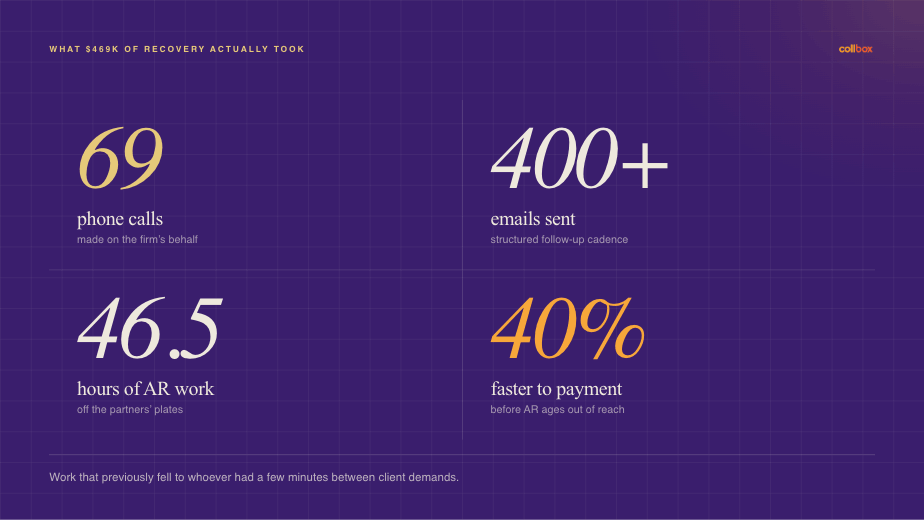
Beyond the dollar figure: 69 phone calls made, 400+ emails sent, and an estimated 46.5 hours of AR work handled, work that previously fell to whoever had a few minutes between client demands.
CollBox also measured a 40% faster average time to payment across the client base. Invoices that would have aged further into the collectability danger zone were addressed earlier, before they became harder to recover.
That matters. The data on AR aging is well-documented: the longer an invoice sits, the harder it becomes to collect. At CollBox, we’ve helped law firms recover over $140 million in unpaid invoices. The pattern is consistent. Old AR doesn’t resolve itself. It compounds.
The Human Side of Collections
One detail from the debrief stands out. Katy noted that her clients responded differently to third-party follow-up than to calls from the firm itself.
“There’s a real psychological difference for the client in receiving a phone call from a third party,” she said. “Most people understood that these people are not in charge of the invoice. They’re just looking at collecting.”
For clients who might have ranted at a firm representative about a disputed item, the CollBox team became the buffer. When a client raised a billing concern, Keegan flagged it for Katy and she handled the conversation from there. The process mirrored how the firm’s internal AR had worked, but without the inconsistency, the scheduling conflicts, or the discomfort of having the same attorneys who built client relationships now chasing payment on them.
This is something Matt Darner, CollBox’s co-founder, talks about often. A study cited during the debrief found that attorneys would rather spend an entire afternoon billing $2,000 in new work than make one phone call to collect $10,000 that’s already owed. That’s not a character flaw. It’s a documented pattern across the profession. And it’s exactly the pattern CollBox was built to interrupt.
“No one went to law school to be a bill collector,” Matt said during the livestream. “But I would add: no one joined a law firm to be one either.”
The psychological relief is real. As Katy put it: “Outsourcing that has been better on my psyche, not only the firm’s recovery time and how much we’re collecting, but also it’s something off my plate. Because it’s not me having that difficult conversation. I have plenty of difficult conversations all day long.”
The Ajax Results (and Why They Matter Here)
It would be incomplete to discuss Ad Astra’s financial turnaround without including what Ajax contributed on the billing capture side. Over a seven-week pilot period across three users, Ajax captured an average of 1.7 extra hours per user per day that hadn’t previously been billed. At Ad Astra’s rates, that translated to approximately $14,500 per user per month in additional billable time. Katy estimated she’s billing 50–70% of the newly captured time. The remaining 30% isn’t wasted. Those line items still appear on the invoice, marked as discounted, and that detail does something important with clients. When a client sees actual work listed at no charge, they feel like they’re getting more than they paid for. The firm builds goodwill on time it was doing anyway. That’s a relationship asset that doesn’t show up in a recovery report but matters in retention and referrals.
“It pays for itself in a day,” Katy said.
The combined impact of billing more accurately and collecting more consistently is exactly what Jay’s diagnostic was designed to surface. Fix the front end of the revenue cycle (time capture), and fix the back end (collection). Both constraints had to move together to change the firm’s financial picture.
That’s the context behind what Katy said at the close of the livestream: “I made more money in January and February. Let’s talk about that.”
There’s a version of this case study that stays in spreadsheet territory, monthly totals, time-to-payment percentages, hours saved. Those numbers are real and they matter. But Katy put it in terms that are harder to argue with. She’d had her eye on an electric Volkswagen ID.Buzz for a while, the kind of purchase that sits in the “someday” column when cash flow is tight and the AR spreadsheet never seems to change. After January and February, someday arrived. She bought it. Named it Frank the Tankless. Matt has already asked if we can get a photo with it for the case study, and she said yes. Watch this space.
What This Means for Your Firm
Ad Astra isn’t an edge case. The constraints Jay identified, time entries recreated rather than captured in real time, AR follow-up dependent on whoever happens to have a free hour that week, are the operational norm at small and mid-sized firms across the country.
Clio’s Legal Trends Report tracks “lockup” as a key metric: the average law firm is now taking over a month to get bills out the door, and collections lockup adds further delay on the back end. The Clio 2024 data showed 71% of clients prefer fixed or flat fees, meaning firms are losing revenue on both ends, billing less than they’ve earned and collecting it more slowly than they need to.
For a six-attorney firm running at meaningful billing rates, that gap isn’t small. It’s the difference between a firm that’s technically profitable and one that actually has cash in the bank.
Matt and the CollBox team have earned recognition to match: CollBox took home first place in the audience vote at the 2026 ABA TECHSHOW Startup Alley and won the Clio 2025 Best Business of Law App Award. But the Ad Astra results are a working example. Real firm. Real numbers. Real AR specialist named Keegan who answered Katy’s emails and made the phone calls she didn’t want to make.
Want to See What’s Sitting in Your Aging Report?
Most firms we talk to don’t know exactly how much they have outstanding past 60 or 90 days. That number is almost always larger than expected, and it almost always includes invoices that could still be recovered with consistent, professional follow-up.
CollBox integrates directly with Clio, MyCase, and Smokeball. Onboarding takes about 30 minutes. Your AR specialist is assigned before you go live.
If you want to talk through what that looks like for your firm specifically, book a call with the team here.
You can also read more on how collectability decay works and what the 90-day threshold means for your firm on the CollBox blog, or see aggregate results from firms we’ve worked with on our results page.
Ad Astra Law Group is a San Francisco litigation boutique serving small and medium businesses. The Law Firm Deconstructed program is produced by Paragon Tech. Time capture data provided by Ajax. AR recovery data provided by CollBox from internal monthly progress reports. Results shared with permission from Ad Astra Law Group, Paragon Tech, and Ajax.
