
Should Your Law Firm Send Unpaid Invoices to a Collection Agency?

CollBox Team
For most small and mid-sized law firms, a traditional collection agency is the wrong first move on unpaid invoices. Agencies typically take 25% to 50% of what they recover, they work debts that are already old and hard to collect, and their consumer-style tactics carry real risk for a firm bound by bar rules and ongoing client relationships. The better question is not “which agency,” but “what should happen to an invoice long before it ever gets to that point.”
New industry data shows why that timing matters more than ever. According to 8am’s July 2026 analysis of several million invoices from tens of thousands of small and mid-sized firms, average overdue balances have climbed 21%, from roughly $2,800 in 2024 to $3,400 in 2026, and the typical overdue bill now sits 131 days past due. Firms are getting paid faster on the invoices clients intend to pay, while the invoices that slip are aging into larger, staler balances. Those are exactly the balances that end up in a “should we call a collection agency” conversation.
What does a collection agency actually do for a law firm?
A collection agency buys or works past-due debt on your behalf, usually on contingency. That model has three consequences worth understanding before you sign anything.
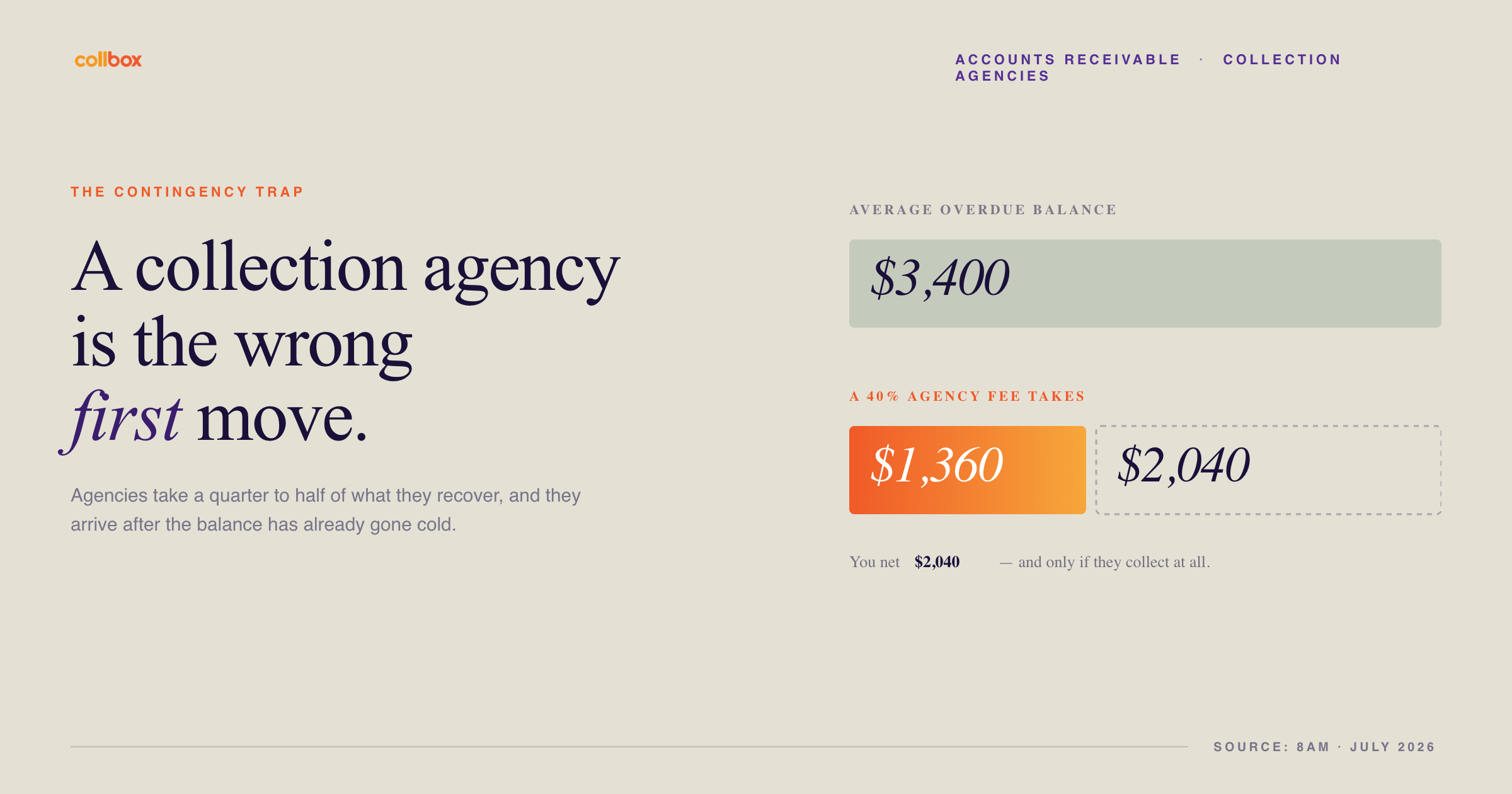
You give up a large share of the recovery. A 40% contingency fee on a $3,400 balance means you net about $2,040, and only if they collect at all.
You hand off control of the client relationship. Agencies are optimized for recovery, not for the reputation of your firm. The tone that works on anonymous consumer debt is not the tone you want used on a former client who may leave a review or refer future work.
You are often engaging them too late. Agencies are built to work aged debt, which is the least collectible kind. By 131 days, the odds have already moved against you.
Is using a collection agency risky for a law firm specifically?
Law firms carry obligations that most businesses do not. Aggressive third-party collection activity can create friction with bar rules around client communication, fee disputes, and confidentiality. It can also turn a recoverable balance into a formal complaint. A client who felt ignored is annoying. A client who feels harassed by a debt collector your firm hired is a different problem entirely.
This is the core reason CollBox exists as a category apart. CollBox is a tech-enabled accounts receivable service built specifically for small and mid-sized law firms, integrating directly with Clio, MyCase, and Smokeball. It is deliberately not a collection agency and not billing software. A real person runs a consistent, professional follow-up cadence on your outstanding invoices, the firm sees every touch, and the client relationship stays intact because the outreach reads as process, not punishment. To date, CollBox has recovered more than $140 million for law firms.
“The instinct when a bill gets old is to reach for a collection agency, but that is usually the most expensive, highest-risk option arriving at the worst possible time. The 8am numbers make the point for us: the invoices going bad are getting bigger, not because clients suddenly stopped paying, but because nobody followed up while the balance was still small. Fix the follow-up and most firms never need an agency at all.” Matt Darner, Co-founder and CEO, CollBox
What is the alternative to a collection agency for unpaid legal fees?
The alternative is a real AR process that starts early and escalates on a schedule, rather than a last-resort handoff of debt that has already gone cold.
That means consistent contact on every past-due invoice, not sporadic reminders when someone remembers. It means a documented cadence with a defined escalation path, so the client understands there is a process behind the follow-up. And it means someone whose actual job is that follow-up, rather than an office manager fitting it between intake and scheduling.
Done early, this recovers more of the balance, costs a fraction of an agency’s contingency, and protects the relationship. Done at 131 days, you are back to picking an agency. The point is to not get there.
Frequently asked questions
When should a law firm send an invoice to collections? Most firms wait far too long. By the time a balance is aged enough to interest a traditional agency, its collectibility has already dropped sharply. A structured follow-up process starting within the first 30 days recovers more, for less, than any agency working the same debt at four or five months.
How much do collection agencies charge law firms? Contingency fees typically range from 25% to 50% of the amount recovered, and higher on older or smaller debts. On the average $3,400 overdue legal balance, that can mean giving up well over a thousand dollars per invoice, assuming the agency collects.
Is CollBox a collection agency? No. CollBox is a tech-enabled accounts receivable service for small and mid-sized law firms. It runs consistent, professional follow-up on your outstanding invoices through your existing practice management system, rather than buying or working aged debt with consumer-style collection tactics.
Will using an outside AR partner hurt my client relationships? It depends entirely on the approach. Agency-style collection can damage relationships and invite complaints. A professional, process-driven follow-up cadence, run in your firm’s name and visible to you at every step, is designed to preserve the relationship while still getting the invoice paid.
See what structured AR recovery looks like
If your firm is sitting on aged invoices and weighing a collection agency, look at the alternative first. Schedule a conversation with the CollBox team to see what recovery looks like for a practice like yours, or check your firm’s AR health with the free Report Card.
